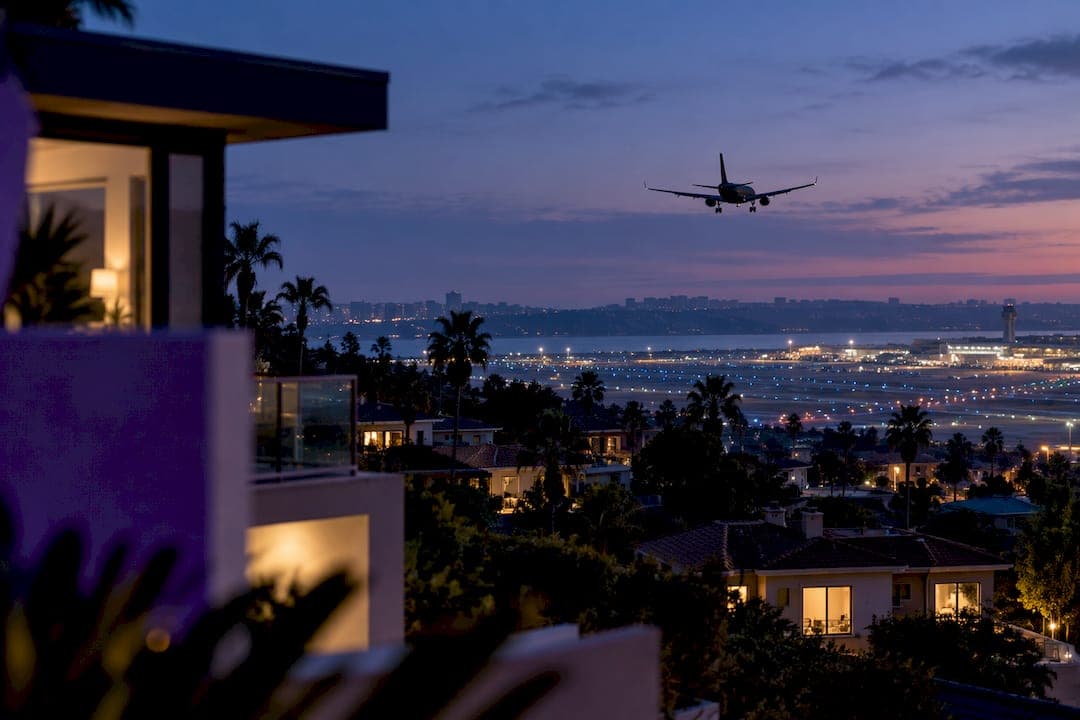
San Diego International Airport enforces a departure curfew between 11:30 p.m. and 6:30 a.m., and homes inside its 65+ decibel noise contour may qualify for free sound insulation through the Quieter Home Program, which targets a 5 dB cut in interior noise. If you want to know whether your street is affected, the fastest move is pulling up SAN's noise contour map and checking live flight activity on WebTrak. Everything else, eligibility rules, complaint procedures, resale impact, builds off that.
TL;DR:
- Homes inside the FAA's 65+ dB noise contour and with interior noise testing of 45 dB or higher qualify for the Quieter Home Program, but neighborhood noise alone is not enough.
- The airport's departure curfew from 11:30 p.m. to 6:30 a.m. is strictly enforced for scheduled jets, excluding arrivals and emergency operations, with fines for violations.
- Checking real-time flight activity and noise contours via WebTrak and the SAN noise map is essential to accurately assess your home's noise exposure and program eligibility.
- The noise policy is managed by SAN and overseen by the FAA, with public input available through meetings and the Fly Quiet Program scoring airlines on noise performance.
- Residents can take immediate action by filing complaints, requesting portable monitoring, and sealing home leaks, but long-term solutions like retrofit programs require waiting for application and testing.
Table of Contents
- Understanding San Diego airport noise rules and limits
- Who sets San Diego airport noise policy
- How to check the San Diego airport noise map for your address
- Does your home qualify for the Quieter Home Program?
- How airport noise shapes home buying and resale in San Diego
- What residents can do right now about aircraft noise
- An agent's perspective on buying near SAN
- How Jeffsellssandiego helps you navigate noise-affected neighborhoods
- Sources
- FAQ
Understanding San Diego airport noise rules and limits
SAN operates one of the more restrictive curfews of any major American airport. Scheduled departures are barred from 11:30 p.m. to 6:30 a.m., though arrivals can land at any hour and emergencies or air traffic control delays are exempt from penalty. That's a real constraint on a single-runway airport wedged into a dense urban corridor, and it's the backbone of every other noise policy that follows it.
By the numbers: The City of San Diego's municipal noise ordinance sets a daytime limit of 88 decibels and a nighttime limit of 70 decibels for general community noise, figures worth knowing when comparing a passing jet to your neighbor's leaf blower.
Enforcement runs through a Curfew Violation Review Panel, which reviews reported violations and can escalate fines for repeat offenders. None of this exists in a vacuum. It's layered on top of the FAA's Part 150 Noise Compatibility Program framework, which governs how airports plan around noise and land use.
A few things to keep in mind about how the curfew actually functions:
- It restricts scheduled jet departures, not general aviation or emergency operations.
- Arrivals are permitted around the clock, so a 1 a.m. landing isn't a violation.
- Air traffic control delays and weather diversions are standard, documented exemptions.
Who sets San Diego airport noise policy
Noise policy at SAN isn't run by one office issuing edicts. The San Diego County Regional Airport Authority manages day to day operations through its Aircraft Noise Office, which tracks flight patterns, fields complaints, and administers the mitigation programs residents actually interact with.

Above that sits the FAA, which reviews and approves the airport's Noise Compatibility Program under Part 150. The FAA approved SAN's updated NCP effective January 11, 2023, accepting 16 of 17 proposed measures, everything from sound insulation funding to land use recommendations.
Two more groups matter if you want a voice in the process:
- The Airport Noise Advisory Committee (ANAC) meets to review noise data and hear public comment, and meetings are open to residents.
- The Fly Quiet Program scores individual airlines on fleet quality, how often they exceed noise thresholds, and curfew compliance, publishing results to pressure carriers into scheduling quieter aircraft at night.
How to check the San Diego airport noise map for your address
Before you assume your block is fine, or assume the worst, look at the actual data. SAN publishes noise contour maps built around the 65 dB CNEL (Community Noise Equivalent Level) threshold, the same line the FAA uses to define which homes qualify for sound insulation funding. Falling inside that contour is the first eligibility test for the Quieter Home Program.
Here's a practical sequence for checking your own address:
- Pull up SAN's aircraft noise page and locate the current noise contour map for your neighborhood.
- Cross-reference your address against the 65 dB line; anything outside it generally won't qualify for QHP funding.
- Open WebTrak to see near-real-time flight tracks and historical noise readings for specific dates and times.
- If patterns seem inconsistent with the published contour, request portable noise monitoring through the Airport Authority.
- Use whatever you find, contour status, WebTrak history, monitoring results, to decide whether QHP or a private retrofit makes more sense.
Pro Tip: Check WebTrak on a weeknight around 11 p.m. and again at 6:30 a.m. Curfew edge cases, the last departure before cutoff and the first arrival after, tend to be the loudest events most residents actually notice.
Does your home qualify for the Quieter Home Program?
The Quieter Home Program is SAN's flagship mitigation tool, and it's more selective than most residents assume. Eligibility requires sitting inside the FAA's 65+ dB contour and testing at an interior average of 45 dB or higher with windows closed. Being in a noisy-sounding neighborhood like Loma Portal or Bankers Hill doesn't automatically qualify a specific house; only measured interior testing does.
Once a home qualifies, the program funds:
- Upgraded windows and doors rated for sound attenuation
- Improved ventilation systems, since sealing a house tighter than before requires mechanical air exchange
- A design assessment tailored to that specific structure's noise exposure
Program scale: SAN recently announced a $15.3 million FAA grant to fund insulation for roughly 400 additional residences, part of a program that has treated thousands of homes over its history.
The process runs application, acoustical testing, design review, construction, then post-construction testing to confirm the 5 dB reduction goal was met. Waiting lists run long, so don't expect fast turnaround. The tradeoff that catches people off guard: participation requires granting a recorded avigation easement against the property. You get free construction work, but that easement travels with the deed to future owners, and it's worth discussing with a realtor before you sign anything.
How airport noise shapes home buying and resale in San Diego
Noise exposure is a real line item in how buyers evaluate a property, whether or not it shows up on a disclosure form. Homes clearly inside the 65 dB contour often see fewer showings and more price sensitivity, particularly from buyers relocating from quieter markets who aren't used to flight paths overhead.
Sellers in affected areas have real options. A completed Quieter Home Program retrofit is a genuine selling point, quantifiable and marketable. Even without QHP, showcasing interior comfort (upgraded windows, good HVAC, effective sealing) reframes the conversation from "there's a noise problem" to "here's how it's handled."
If you're buying near SAN, ask these questions before you write an offer:
- Has this specific home completed Quieter Home Program treatment, or just neighboring properties?
- Is there an avigation easement recorded on the title?
- What does interior noise actually sound like at different times of day, not just during a daytime showing?
- How has flight volume over this address trended in the last few years?
A local agent who understands neighborhood-level noise patterns can help you weigh those answers against price and location tradeoffs that generic market data won't capture.
What residents can do right now about aircraft noise
You don't have to wait for a program rollout to take action. Here's where to start:
- File a complaint through WebTrak or SAN's noise hotline, including the date, approximate time, and flight direction if you can note it.
- Request portable noise monitoring if you believe your street's exposure doesn't match the published contour.
- Address quick wins at home: seal window and door gaps, run HVAC ventilation instead of open windows, and consider white noise machines for bedrooms facing flight paths.
- For bigger, long-term fixes, check QHP eligibility or price out a private acoustic retrofit.
- Show up to an ANAC meeting or read the published Fly Quiet Report to see how your most common carriers actually score.
Pro Tip: Complaints tied to a specific WebTrak flight track carry more weight with the Airport Authority than a general "it's loud at night" report. Screenshot the flight before you file.
An agent's perspective on buying near SAN
Every buyer looking within a few miles of the flight path asks about noise eventually, and the honest answer is that it's a factor to price in, not a reason to walk away automatically. I've watched noise concerns kill deals that would've closed fine with better information, and I've seen buyers skip genuinely good value because they didn't understand QHP status or easement history. My job is separating the real tradeoffs from the assumptions.
— Jeff
How Jeffsellssandiego helps you navigate noise-affected neighborhoods
Figuring out whether a house near the flight path is a smart buy, or whether your own home's noise exposure is hurting its resale value, isn't something a noise map alone can answer. That's where local, transaction-focused guidance matters more than another spreadsheet of decibel readings.

With Jeffsellssandiego's Buy With Confidence service, you get help interpreting QHP eligibility, easement history, and flight pattern trends for specific addresses, not just general contour lines. If you're selling, a Home Valuation accounts for how noise exposure and any completed retrofits actually affect what buyers will pay in your specific neighborhood. And if you're searching for a quieter alternative altogether, VIP Home Search lets you filter for interior comfort features and flight path distance from the start, instead of finding out after you've fallen in love with a listing. Request a valuation or a neighborhood consultation to see exactly where your address stands.
Sources
- Aircraft Noise - SAN Airport
- Noise Compatibility Program for San Diego International Airport, San Diego County, California - Federal Register
FAQ
Is there a noise ordinance for San Diego airport?
Yes. The City of San Diego enforces a general noise ordinance capping daytime noise at 88 decibels and nighttime noise at 70 decibels, and SAN separately enforces a departure curfew from 11:30 p.m. to 6:30 a.m. Curfew violations go through a formal review panel with escalating fines for repeat offenders.
What is going on at San Diego airport right now?
The clearest way to see current activity is WebTrak, which shows near-real-time flight tracks and noise monitoring data for SAN. It also lets you review historical flights if you're trying to identify a specific plane you heard earlier.
Why did I just hear a loud plane?
Most loud aircraft noise near SAN comes from departures climbing out over nearby neighborhoods or arrivals on final approach, both of which vary by wind direction and runway configuration. Checking WebTrak for the exact time you heard it will usually show the specific flight and altitude.
Is there a loud noise in San Diego today?
Noise levels fluctuate with flight schedules, weather-driven runway changes, and time of day, so there's no single daily answer. WebTrak provides the most current picture, and residents near the flight path can request portable noise monitoring if levels seem unusually high on a given day.
Does my home qualify for the Quieter Home Program?
Only if it falls inside the FAA's 65+ dB noise contour and tests at an interior average of 45 dB or higher with windows closed. Neighborhood location alone doesn't determine eligibility; the Quieter Home Program requires actual acoustical testing at your specific address.