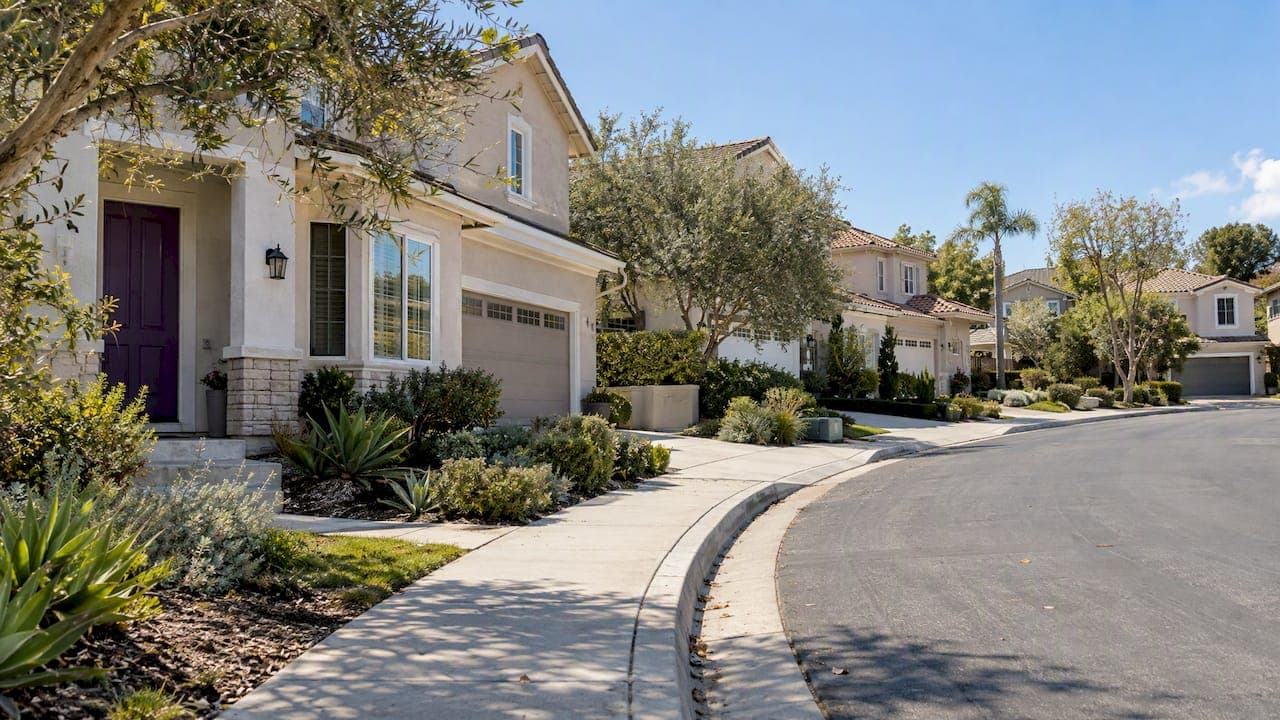
Carmel Valley, Scripps Ranch, Rancho Peñasquitos, Rancho Bernardo and the small pocket of Burlingame come up again and again as the safest places to live in San Diego, and the city's own crime reports back much of that up. But "safest" depends on the numbers you use, the year you look at and what safety means to you. This guide walks through what the official data says, how to read it, and how to check any specific address before you make an offer.
TL;DR
- San Diego as a whole ranks among the safest large U.S. cities, with a 2024 violent-crime rate of 4.3 per 1,000 residents.
- Inland suburban communities such as Carmel Valley, Scripps Ranch, Rancho Peñasquitos and Rancho Bernardo are the names that show up most often in safety rankings. Burlingame, a tiny pocket, posted extremely low numbers.
- Raw crime counts mislead. Compare rates per 1,000 residents, and look at several years, not one.
- Safety is also about wildfire, earthquake and flood exposure, not just crime.
- Before you buy, check the city's neighborhood crime dashboard for the exact block, then visit at different times of day.
Table of Contents
- How San Diego compares with other big cities
- The neighborhoods that keep coming up
- Reading the numbers: what the data does and does not say
- Safety is more than crime
- How to check the safety of a specific address
- A perspective from our side of the table
- Turning a shortlist into a home
- Work with a local agent on your search
- FAQ
- Sources
How San Diego compares with other big cities
Start with the big picture. The San Diego Police Department reported that overall crime fell 1.5% in 2024 and described San Diego as one of the safest large cities in the country, with a violent-crime rate of 4.3 per 1,000 residents.
That answers the common question of whether San Diego is one of the safest big U.S. cities: generally yes, when you compare it with other cities of similar size. It does not mean every block is the same. Within the city, the gap between the calmest and busiest neighborhoods is wide, and that is what the rest of this article is about.
The neighborhoods that keep coming up
No single list is official. San Diego does not crown a "safest neighborhood." What you can do is compare what the police department publishes with what local reporting and long-time residents say. Here is where the evidence points.
Carmel Valley
Carmel Valley is the most frequently named safe neighborhood, and its official numbers are solid for an area with a large population. In the SDPD's 2023 neighborhood rate report, Carmel Valley recorded 0.3 aggravated assaults and 1.2 simple assaults per 1,000 residents. The 2023 counts list 111 crimes against persons in total, with no homicides or kidnappings, seven sexual assaults, 16 aggravated assaults and 62 simple assaults.
Carmel Valley is a planned, largely newer community with a lot of detached homes, townhomes and condos, and it sits in some of the city's most sought-after school territory. That demand is reflected in prices, so safety here comes with a cost.
Scripps Ranch
Scripps Ranch is a quiet, tree-lined suburb in the northeast part of the city. The 2023 report lists 65 crimes against persons there, a modest total for a residential community of its size. It is a good example of the pattern buyers look for: single-family streets, cul-de-sacs, low through traffic and a strong neighborhood association feel.
Rancho Peñasquitos and Rancho Bernardo
These two North County Inland communities, both within the City of San Diego, regularly appear in family-oriented safety roundups alongside Carmel Valley and Scripps Ranch. They tend to offer more space for the money than the coastal areas, with parks, trails and established schools. Because they are large, check the specific part of the neighborhood you are considering, since conditions near a commercial corridor can differ from a street inside a residential tract.
Poway
Poway is its own city, not a San Diego neighborhood, but buyers searching for "safe areas" often include it. San Diego Magazine's analysis found that Poway had the lowest average violent-crime rate among the county's incorporated areas in the period it studied. If you work in northern San Diego and want a small-city feel, it belongs on your list.
Burlingame: the outlier
The same San Diego Magazine piece highlighted Burlingame, a very small residential pocket, for recording just four violent crimes from 2009 to 2018. The city's 2023 report shows it with 3 crimes against persons: no homicide, kidnapping or sexual assault, and three aggravated assaults. Torrey Preserve and Wooded Area each logged just two.
Be careful with these tiny areas. They have few residents, so a handful of incidents would change the picture, and a quiet street of a few dozen homes is not a neighborhood most buyers can actually shop in. The lesson is the one the magazine's analysis points to: safety can be highly specific, down to the micro-area.
Coastal options: La Jolla, Del Mar and Encinitas
If you want to be near the beach, La Jolla is the best-known low-crime coastal choice within city limits. In the 2023 rate report, La Jolla recorded 0.8 aggravated assaults and 1.9 simple assaults per 1,000 residents. That is a little higher than Carmel Valley's rates, which makes sense: La Jolla draws heavy tourist and visitor traffic, so its numbers include people who do not live there. Del Mar and Encinitas are separate North County coastal cities that are often mentioned in the same breath.

Reading the numbers: what the data does and does not say

The 2023 city report puts the contrast in plain terms. Burlingame logged 3 crimes against persons and Carmel Valley 111, while East Village recorded 850 and the Gaslamp 369. Downtown neighborhoods see enormous daytime, nightlife and visitor populations, so the comparison is not apples to apples. Still, it shows why most buyers who want a quiet residential setting look north and inland.
A few rules will keep you from misreading any ranking you find online.
- Prefer rates over counts. A neighborhood of 60,000 people will always log more incidents than one of 2,000. The city publishes a rate-per-1,000 report for exactly this reason.
- Remember visitors. Places with beaches, shopping centers, hospitals or entertainment venues inflate counts with people who do not live there.
- Look at more than one year. The city's annual crime reports cover 2023, 2024 and 2025, and older reports go back decades. A single odd year can mislead.
- Know the reporting changed. In 2021 the SDPD began reporting to the FBI's NIBRS system, which, according to the city's open data portal, collects data on all crimes reported, not just the most serious charge in each incident. Counts from before and after the switch are not directly comparable.
- Treat the data as live. The same portal notes that records are updated daily and can change or be removed as investigations proceed.
Property crime is a different question
Most safety rankings lean on violent crime, but for a homeowner, car break-ins, package theft and burglary affect daily life more often. The city's NIBRS data sorts offenses into crimes against persons, property and society, so look at the property category too before you decide that a neighborhood is a fit.
Safety is more than crime
A neighborhood with almost no crime can still carry other risks. San Diego Magazine points out that "safety" is complicated: low-crime communities may sit in high fire hazard zones, and earthquake risk and sea-level rise belong in the conversation as well.
For a buyer, that translates into practical questions:
- Wildfire. Is the home near canyons, open space or chaparral? Ask your insurer early, since coverage and cost can vary sharply by location.
- Flooding and coastal erosion. Low-lying coastal and canyon-bottom lots deserve a closer look.
- Earthquake. Ask about the home's construction, retrofit work and the property's location relative to mapped fault zones.
- Traffic and walkability. A quiet cul-de-sac and a busy arterial a block away feel very different, whatever the crime numbers say.
The hand-in-hand question is cost. The safest neighborhoods are rarely the cheapest, so work out what you can afford before you fall for a street. Getting a mortgage pre-approval first tells you which of these neighborhoods are realistically in range.
How to check the safety of a specific address
Rankings get you a shortlist. The address is what matters. Here is a process that works.
- Open the city's neighborhood crime dashboard. The SDPD's crime statistics page points to a Neighborhood Crime Summary Dashboard with near-real-time trends, crime categories and incident-location clusters, filterable by neighborhood.
- Dig into the raw data if you want detail. The open data portal includes the date and time of reported offenses, the category and the hundred-block address, with records back to January 2020.
- Compare two or three neighborhoods side by side using the per-1,000 rate report, not the raw totals.
- Visit at different times. Go on a weekday morning, a weeknight and a Saturday afternoon. Note street lighting, parked cars, noise and how neighbors use the street.
- Talk to people who live there. Neighbors will tell you about the break-in cluster, the loud intersection or the fire evacuation that no database captures.
- Ask your agent for the local picture. An agent who works a neighborhood week after week hears what is happening long before it shows up in a report.
A perspective from our side of the table
We have spent more than two decades working San Diego real estate, and the safety question comes up in nearly every buyer conversation. Our honest view: the data is a starting point, never the verdict.
We tell buyers to treat a neighborhood name as a range, not a promise. Two streets in the same community can feel very different, and the best-value homes are often a few blocks from the postcard address. We also push buyers to think about the whole picture: commute, school boundaries, fire and insurance questions, resale demand and what the home will cost to carry. A safe, well-loved neighborhood tends to hold its appeal when you sell, which matters as much as how it feels on day one.
If you are early in your search, our San Diego neighborhood guide and family neighborhoods guide are good places to compare areas by lifestyle as well as by safety.
— Jeff
Turning a shortlist into a home
Once you have two or three neighborhoods that feel right, the work becomes practical: narrowing streets, timing showings and writing an offer that is competitive without overpaying. Our property search tips for San Diego buyers cover how to do this efficiently, and the first-time buyer checklist walks through inspections, financing and closing. If you are moving from out of the area, our moving guide for homebuyers helps with the timing. Our neighborhood pages show what each area looks like on the market.
If you are a homeowner in one of these sought-after communities, the same safety reputation is a selling point. Knowing how buyers think about it helps you price and market your home with confidence. A home valuation is a good first step.
Work with a local agent on your search
Choosing a neighborhood is the most important decision in a home purchase, and it is easier with someone who knows each area block by block. Our buyer service, Buy With Confidence, gives you personalized guidance from the first showing through closing, and our VIP Home Search delivers listings that match the neighborhoods and criteria you set.

Tell us which areas you are considering and what safety means to you, and we will help you compare them with real local knowledge. Thinking of selling instead? See how Sell With Strategy works.
FAQ
What is the safest neighborhood in San Diego?
There is no official winner. Carmel Valley, Scripps Ranch, Rancho Peñasquitos and Rancho Bernardo are the names most often cited, and the small pocket of Burlingame recorded very few crimes. The best choice depends on rates, not totals, and on the specific street you are considering.
Is San Diego one of the safest cities in the U.S.?
Among large cities, generally yes. The SDPD reported a violent-crime rate of 4.3 per 1,000 residents in 2024 and a 1.5% drop in overall crime. Individual neighborhoods vary widely, and downtown areas record far more incidents than residential suburbs.
Where can I see crime data for a particular address?
Use the city's neighborhood crime dashboard, reached through the SDPD crime statistics pages. For incident-level detail, the open data portal lists offenses by category and hundred-block address.
Are the safest neighborhoods also the most expensive?
Often, yes, especially near top-rated schools and the coast. Inland communities generally give you more space for the money than coastal ones, but prices vary by street and home type. Getting pre-approved first shows what you can realistically afford.
Does low crime mean a neighborhood is risk-free?
No. Low-crime areas can still face wildfire, earthquake or flooding risks, as San Diego Magazine notes. Ask about insurance and hazard zones before you commit.
Sources
- San Diego Remains One of the Safest, Large U.S. Cities (City of San Diego)
- Crimes Against Persons January to December 2023 (SDPD)
- Crimes Against Persons 2023, Rate Per 1,000 Residents (SDPD)
- City of San Diego Annual Crime Reports
- City of San Diego Open Data Portal: SDPD NIBRS
- Crime Statistics & Crime Mapping (City of San Diego)
- Where's the Safest Place to Live in San Diego? (San Diego Magazine)