
On a typical home sale with a 5% total commission rate, the seller pays agent fees amounting to a percentage of the sale price before closing costs. The formula is straightforward: commission = sale price × commission rate. That $25,000 typically splits down the middle, so the listing agent's side gets $12,500 and the buyer's agent side gets $12,500. Your net proceeds are what's left after that commission, your mortgage payoff, and other closing costs come out of the sale price.
A few things worth knowing upfront:
- Commission rates in real estate are fully negotiable. There is no legally mandated standard rate in the United States.
- The 2024 NAR settlement changed how buyer-agent compensation is disclosed and paid. Buyer fees can no longer be published on the MLS and must now be handled through written agreements.
- Seller closing costs beyond commission (transfer taxes, title, prorated taxes) typically add another 1–4% on top of agent fees, according to CalcFi's closing cost data.
Run the numbers before you sign anything.
Key Takeaways
Negotiating your commission rate before signing a listing agreement is the single highest-leverage financial decision in any home sale.
| Point | Details |
|---|---|
| Core formula | Commission = sale price × rate; a 5% rate on $600,000 produces $25,000 in total agent fees. |
| Splits reduce agent take-home | A $15,000 side commission becomes $10,500 at a 70/30 agent/broker split — context that shapes realistic negotiation. |
| Post-2024 buyer fees | After the NAR settlement, buyer-agent compensation must be in writing and can no longer be published on the MLS. |
| Full net proceeds math | Add transfer taxes, title, prorated taxes, and mortgage payoff to commission to get your real number; total seller costs often run 6%–10% of sale price. |
| Jeffsellssandiego | Offers a free commission calculation and local market valuation as part of every San Diego listing consultation. |
Table of Contents
- What does a real estate commission calculator need to work?
- How to calculate real estate commission by hand
- Commission models, who pays, and what the 2024 NAR settlement changed
- Other costs that cut into your net proceeds
- Commission amounts at common sale prices and rates
- Which online calculators are worth your time?
- What I've learned negotiating commissions in San Diego
- Jeffsellssandiego can run these numbers with you
- Sources
What does a real estate commission calculator need to work?
A good real estate commission calculator does more than multiply your sale price by a percentage. To get a number you can actually use in a negotiation, you need to feed it the right inputs and know what the outputs are telling you.
Essential inputs:
- Sale price — the agreed or estimated selling price of the property
- Total commission rate — or separate listing-side and buyer-side rates (e.g., 2.5% + 2.5%)
- Rebates or concessions — any credit the agent offers back to the buyer or seller
- Advertising and marketing fees — some brokerages charge these separately from the commission percentage
- Mortgage payoff balance — needed to calculate true net proceeds
- Other closing costs — transfer taxes, title insurance, prorated property taxes (optional but useful)
What the calculator returns:
- Gross commission — total dollars paid to both agent sides
- Commission per side — listing agent's share vs. buyer agent's share
- Net commission cost — after any rebates or negotiated discounts
- Estimated net proceeds — sale price minus commission minus mortgage payoff minus other costs
The Mortgagecalculator supports all of these fields, including rebates and advertising costs, and produces both a net commission cost and a net proceeds figure. That makes it one of the more complete free options available.
Sanity-checking your results: After running any calculator, do a quick manual check. Multiply your sale price by the total rate. If the calculator's gross commission doesn't match within a few dollars, check whether it's applying the rate to the net sale price or the gross, and whether any fees are being double-counted.
How to calculate real estate commission by hand
Manual math takes about two minutes and gives you a check against any calculator output. Here's how to work through it step by step.
Step 1: Calculate total commission Total commission = sale price × total commission rate $600,000 × 0.05 = $30,000
Step 2: Split by side Listing fee = sale price × listing rate → $600,000 × 0.025 = $15,000 Buyer fee = sale price × buyer rate → $600,000 × 0.025 = $15,000
Step 3: Apply the brokerage split Most agents don't keep the full side commission. According to the Bureau of Labor Statistics, real estate agents work on commission and split their earnings with their brokerage. Common splits are 50/50 or 70/30 (agent/broker).
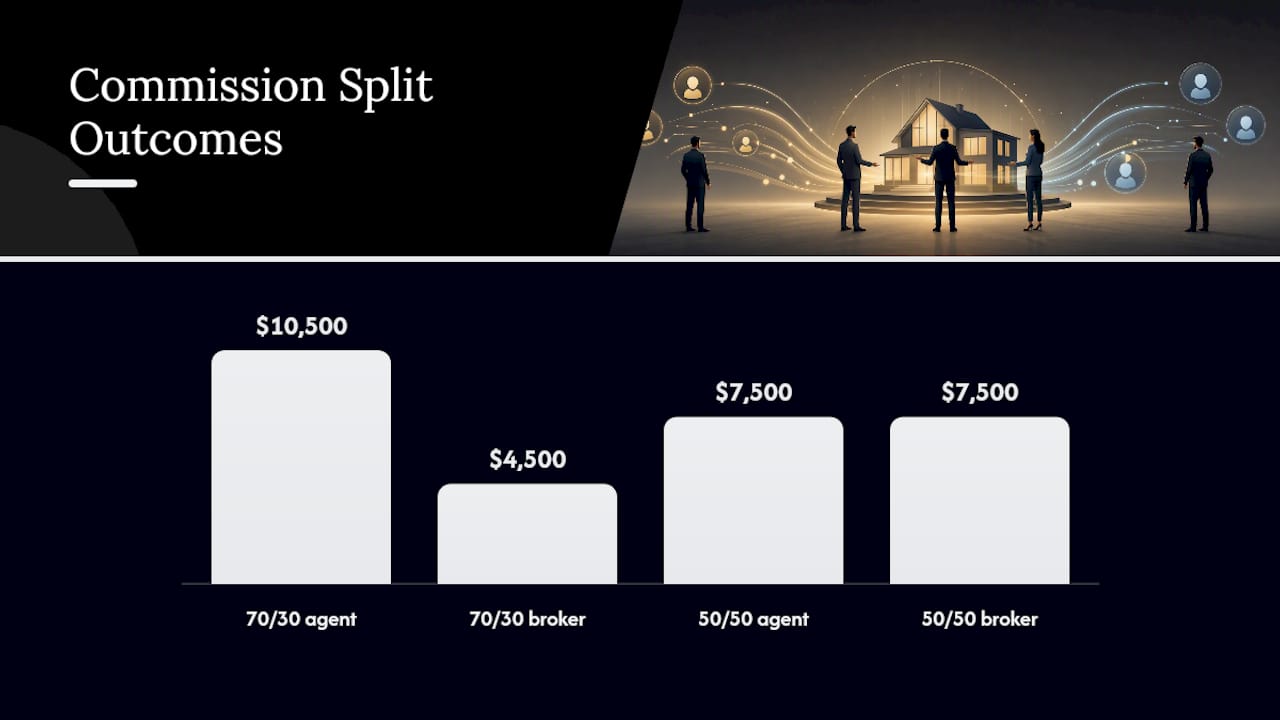
Step 4: Calculate agent take-home At a 70/30 split on a $15,000 side: agent keeps $10,500, broker takes $4,500. At a 50/50 split on a $15,000 side: agent keeps $7,500, broker takes $7,500.
Note: "Side commission" above reflects one agent's share of the total commission before the brokerage cut. Agent take-home figures apply to the listing-side agent at the stated split.
Understanding this math matters for negotiation. That context helps you make a realistic ask rather than an insulting one.
Commission models, who pays, and what the 2024 NAR settlement changed
Real estate commissions aren't one-size-fits-all. Knowing the models gives you real negotiation leverage.
Percentage-based commission is the most common structure. The listing agent's brokerage then distributes the buyer-side fee to the buyer's agent's brokerage.
Flat-fee listing charges a fixed dollar amount regardless of sale price. This can work well for higher-priced homes where a percentage fee would be disproportionate to the work involved.
Tiered rates drop the percentage as the sale price rises.
Rebates and credits return a portion of the commission to the buyer or seller at closing. These are legal in most states, though DOJ guidance notes that a handful of states still restrict or prohibit them. Check your state's rules before counting on one. For state-by-state rebate details, the DOJ's rebate guidance page is the clearest primary source.
Buyer representation agreements are now standard practice following the August 2024 NAR settlement. Buyer-agent compensation can no longer be advertised on the MLS. Instead, buyers and their agents negotiate compensation in writing before touring homes. Sellers can still offer to cover the buyer's agent fee as a concession, but it's no longer automatic or MLS-published.
Negotiation questions worth asking your agent:
- What specific services are included in your commission?
- Do you charge separate advertising or marketing fees?
- Are you open to a tiered rate if the home sells above a target price?
- Will you offer a rebate if I bring a buyer directly?
- What happens to your fee if the home doesn't sell?
Pro Tip: Ask agents to put their full fee structure in writing before you sign a listing agreement. Post-settlement, written terms aren't just good practice — in many situations they're required. Comparing written proposals from three agents is the single fastest way to find negotiating room.
For a deeper look at how broker representation agreements work in San Diego specifically, that local guide covers the post-2024 changes in plain language.
Other costs that cut into your net proceeds
Commission is the biggest line item, but it's not the only one. Sellers in most markets pay several additional costs that a commission-only calculator won't capture.
Common seller closing costs beyond commission:
- Transfer taxes (varies by county and state)
- Owner's title insurance policy
- Prorated property taxes for the portion of the year you owned the home
- HOA transfer fees and prorated dues
- Repair credits or concessions negotiated with the buyer
- Staging and professional photography (sometimes charged separately by the brokerage)
- Attorney fees (required in some states, optional in others)
According to CalcFi's closing cost calculator, total seller closing costs often run 6%–10% of the sale price when commission and these additional items are combined.
Here's an adjusted net-proceeds calculation for a $600,000 sale:
That $210,500 is what actually lands in your account. Running this full calculation, not just the commission line, separates a realistic budget from a surprise at the closing table.
Commission amounts at common sale prices and rates
Here's a fast-reference table showing total commission and per-side splits at three common rates, based on the formula and example structures from Bankrate's commission guide.
That's a real number worth negotiating over.
Luxury and commercial listings often carry lower percentage rates precisely because the dollar amounts are large. Agents in those markets frequently accept lower rates because the per-transaction dollar value compensates for it. Commission rates in Georgia and other regional markets show similar patterns, as detailed in this Georgia commission guide, which illustrates how local norms vary considerably from national averages.
Which online calculators are worth your time?
Three tools stand out for different use cases.
MortgageCalculator.org is the most complete free option for sellers. It handles sale price, commission rate, rebates, advertising costs, and produces both a net commission cost and a net proceeds figure. If you want to model what a $2,000 rebate does to your bottom line, this is the tool to use.
CalcFi's commission calculator is strong for modeling negotiated discounts and flat-fee scenarios. It shows net-proceeds outputs and lets you compare a standard percentage deal against a flat-fee listing side by side.
Paperless Pipeline is primarily an agent and brokerage transaction management platform, not a consumer-facing calculator. It's worth knowing about because agents use it to track splits, advertising fees, and tiered commission structures. If your agent references their "pipeline" or transaction management system, this is likely what they mean — and understanding it helps you ask better questions about how their fees are structured.
When to use a calculator versus manual math: use a calculator for speed and scenario modeling. Use manual math to verify the output and catch errors. For negotiation, run at least three scenarios (current rate, negotiated rate, flat-fee alternative) and save screenshots or PDFs of each. Bringing printed numbers to a listing appointment signals that you've done your homework.
What I've learned negotiating commissions in San Diego
San Diego's market has some quirks that generic commission advice misses. Neighborhoods like Point Loma, Mission Hills, and North Park move fast when inventory is tight, and in those conditions, agents have less incentive to discount.
That said, the post-2024 environment has made the buyer-side fee more negotiable than it's ever been. Sellers who offer a buyer-agent concession as a line item in the purchase contract rather than embedding it in the commission structure have more flexibility to adjust it deal by deal. That's a real lever, and most sellers don't use it.
My honest view: the headline rate matters less than what the agent actually does for it. The value of a skilled agent shows up in the final sale price, not just the fee line.

For sellers in slower San Diego neighborhoods or with properties that need work, flat-fee or tiered structures are worth exploring. The math changes when days on market stretch past 30.
Pro Tip: Before signing any listing agreement, ask the agent to show you their last five closed transactions in your neighborhood. Agents who consistently sell above list price in your area are worth paying full commission. Agents who don't have recent local comps are worth negotiating harder.
Jeffsellssandiego can run these numbers with you
Calculating commissions on paper is one thing. Knowing whether a proposed rate is fair for your specific San Diego neighborhood, property condition, and current market timing is another.

Jeffsellssandiego offers a free commission calculation as part of every listing consultation, along with a local market valuation so you know what your home is actually worth before you agree to any fee structure. If you've already received proposals from other agents, bring them. Comparing written fee proposals side by side is exactly the kind of conversation that leads to a better deal for you. Whether you're selling in Point Loma, San Carlos, or anywhere across San Diego County, the consultation covers your realistic net proceeds, not just the gross commission number. Schedule a seller consultation to get started.
Sources
Authoritative references used throughout this guide:
- NAR settlement FAQ — National Association of Realtors
- Mortgagecalculator
- Real Estate Commissions: How Much Do Agents Make? — Bankrate
This article is general information, not a substitute for advice from a qualified financial advisor. Consult a qualified financial professional about your own circumstances before acting on anything here.