
A rate buydown is worth pursuing in San Diego when someone else is paying for it (a seller or builder offering a temporary 2-1 or 3-2-1 buydown) or when you're buying permanent points and plan to stay put for at least five to seven years. If you're funding it yourself on a home you might sell in three years, the math rarely works. The rest of this comes down to who pays, how long you keep the loan, and whether local assistance dollars free up cash to make it worthwhile.
TL;DR:
- Buyers should prioritize seller- or builder-funded temporary buydowns when they are offering immediate payment relief that can be cost-effective.
- Permanent buydowns require paying points upfront, which makes sense only if the buyer plans to hold the home for at least five to seven years.
- The typical cost for points is about 1% of the loan amount per 0.25% interest reduction, with a $650,000 loan costing roughly $6,500 per point.
- Local assistance programs can free up funds for buydowns by covering down payments and closing costs, but require early coordination and verification.
- Buyers need to confirm how buydown funds are disclosed and escrowed, asking detailed questions to avoid hidden costs or unfavorable terms.
Table of Contents
- How a Rate Buydown Actually Works in San Diego
- Costs, Lender Caps, and What Loan Types Allow It
- The Break-Even Math: A Worked San Diego Example
- San Diego Assistance Programs That Change the Math
- What to Ask Lenders and Sellers Before You Commit
- Local Agent Perspective: When I Recommend a Buydown
- How Jeff Hinds Helps San Diego Buyers Work the Numbers
- Sources
- FAQ
How a Rate Buydown Actually Works in San Diego
There are two completely different products hiding under one name, and mixing them up is one of the most common mistakes buyers make when a lender or builder brings this up.
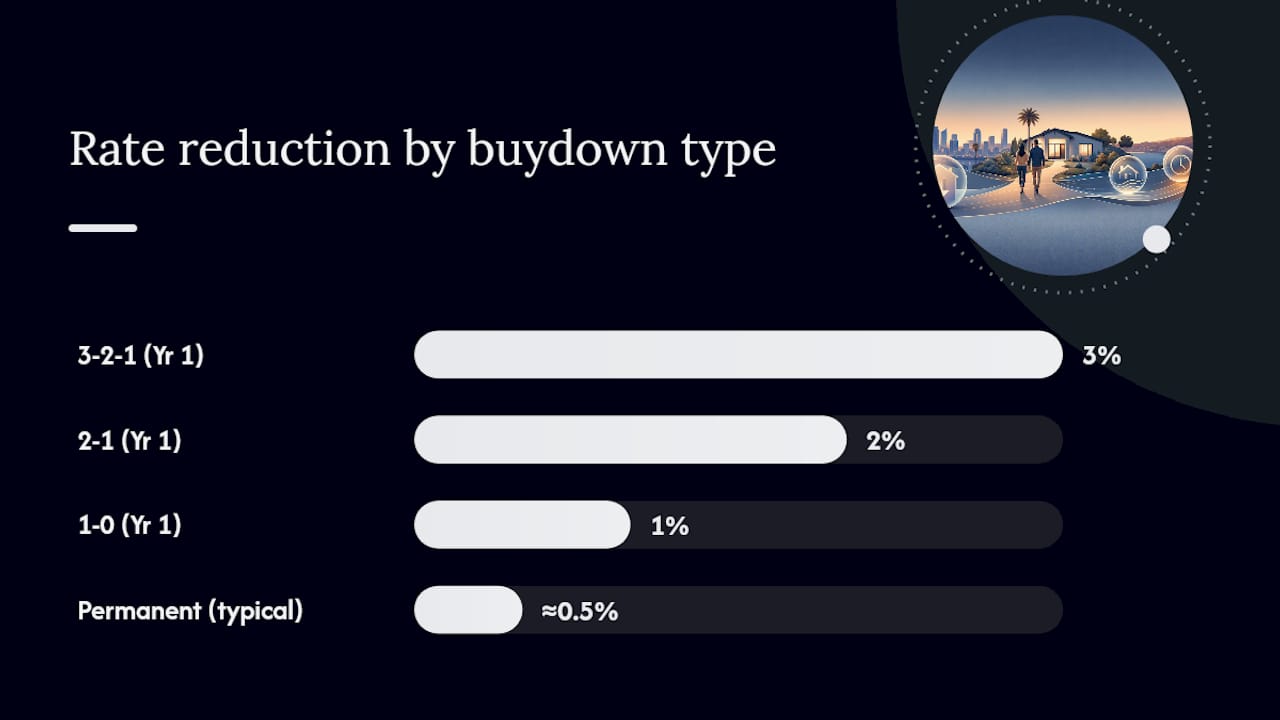
A permanent buydown means you're purchasing discount points to lower your interest rate for the life of the loan. One point costs 1% of your loan amount and typically shaves about 0.25% off your rate, though the exact reduction varies by lender. Pay points equivalent to about 2% of your loan amount upfront to reduce your interest rate by roughly half a percentage point for the life of the loan.
A temporary buydown doesn't touch the note rate at all; for more details on rate lock mechanics and timing, see What Does Rate Lock Mean for a CD? Your Answer. Instead, someone deposits money into an escrow account that subsidizes your payment for a set period. The most common structures:
- 2-1 buydown: rate is 2% lower in year one, 1% lower in year two, then jumps to the full rate in year three
- 3-2-1 buydown: 3% lower in year one, 2% in year two, 1% in year three
- 1-0 buydown: 1% lower for just the first year
Builders and sellers fund these far more often than buyers do, since the money essentially works like a price concession dressed up as payment relief. Lenders sometimes offer credits toward the same structure, though the funding mechanics work the same regardless of who writes the check.
Costs, Lender Caps, and What Loan Types Allow It
A discount point typically costs about 1% of the loan amount and usually reduces the interest rate by about 0.25%, though this ratio varies with lender and market conditions.
A quick gut-check on cost: on a $650,000 loan, one point runs $6,500. Two points run $13,000. Whether that's a good trade depends entirely on how long you'll hold the loan, which is exactly what the break-even math below answers.
Lenders don't treat buydowns uniformly. Some cap the number of points you can buy. Others restrict temporary buydowns on cash-out refinances or investment properties, and jumbo loan programs sometimes exclude buydowns entirely. Chase's guidance on points pricing echoes what most major lenders confirm: the 1-point-to-0.25%-rate ratio is a general guideline, not a guarantee.
A few things worth confirming before you commit:
- Ask whether the loan program (conventional, FHA, VA, jumbo) permits temporary buydowns at all
- Confirm how the seller-funded subsidy is disclosed on your Closing Disclosure and whether it affects your APR calculation
- Verify the escrow account's terms if you refinance or sell before the subsidy period ends
The Break-Even Math: A Worked San Diego Example
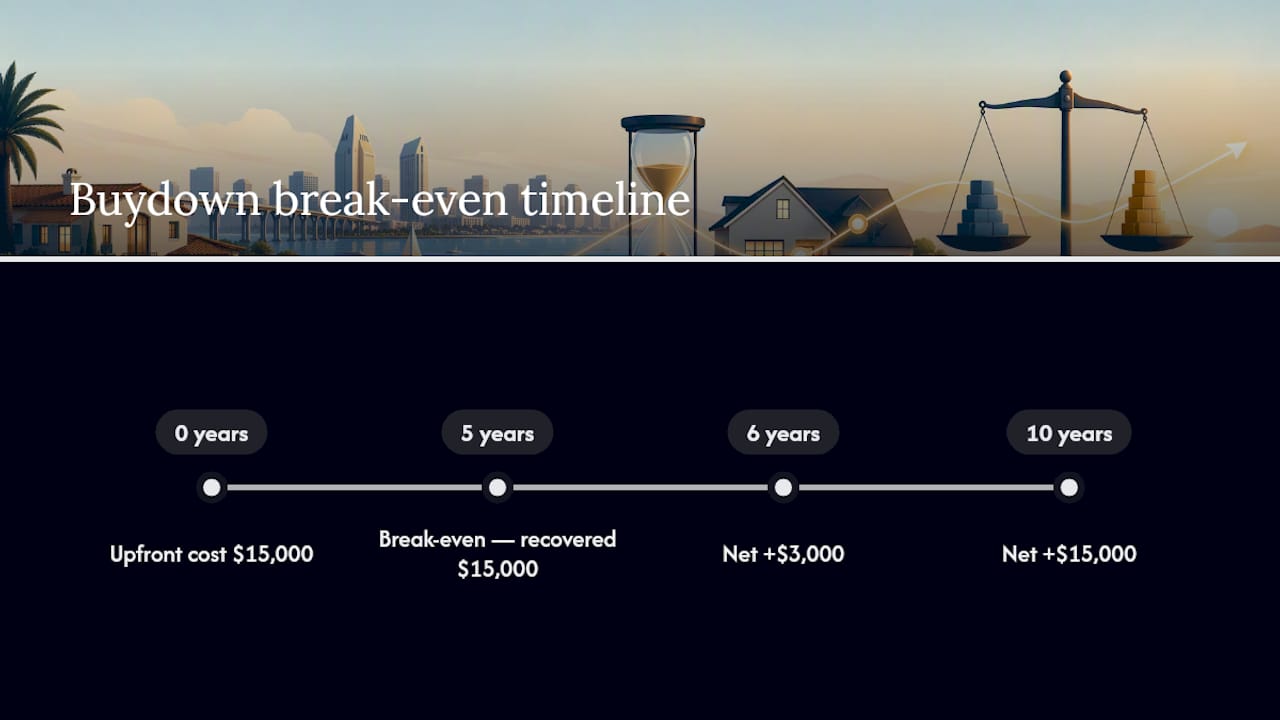
Here's a permanent buydown example using numbers typical of a San Diego purchase. Say you're financing $750,000 at a 30-year fixed note rate of 6.75%. Buying two points costs $15,000 and drops your rate to roughly 6.25%.
At $250 saved per month, it would take approximately five years to recover the upfront cost spent on points. Stay in the home six years and you're ahead by $3,000. Stay ten years and you've saved $15,000 net over the life of the loan compared to not buying points.
Pro Tip: Run this same calculation with your actual loan size before assuming buydown math from a friend's purchase applies to yours. A $500,000 loan and a $1,000,000 loan produce very different break-even timelines even at identical rates, since point cost and monthly savings both scale with loan size.
For a temporary buydown, the math flips. There's no upfront cost to you if the seller or builder is funding it, so the only real question is whether the lower early payments actually help your cash flow while you settle into the home, furnish it, or wait for a partner's income to kick in.
San Diego Assistance Programs That Change the Math
San Diego buyers have an advantage most national buydown calculators ignore: local down payment and closing cost assistance that can free up cash specifically for buying points.
The San Diego Housing Commission runs deferred-payment loan programs for qualifying buyers. Because these funds cover down payment or closing costs rather than the purchase price itself. They can indirectly free up cash you'd otherwise need for points.
Here's how to work that into your buydown decision:
- Contact SDHC or your lender's community lending desk early to check current AMI limits and available funding, since programs adjust year to year
- Gather income documentation (pay stubs, tax returns, asset statements) before you're under contract, since assistance approval takes time
- Ask your agent to request seller or builder concessions explicitly earmarked for a buydown, not just a generic price reduction
- Confirm with your lender whether assistance funds can stack with a seller-funded temporary buydown on the same transaction
Pro Tip: Ask specifically whether the assistance program funds are disbursed at closing or reimbursed after, since timing affects whether you can use them to cover buydown costs versus just your down payment.
What to Ask Lenders and Sellers Before You Commit
Getting a buydown quote is easy. Getting the terms that actually protect you takes a short list of pointed questions.
- Ask your lender exactly how many points are allowed on your loan program and whether you qualify at the note rate or the reduced rate (it's almost always the note rate, per Rocket Mortgage's guidance)
- Ask how the escrow subsidy is disclosed on your Loan Estimate and Closing Disclosure, since this affects your APR
- Ask the seller or builder whether the buydown funds are contractually escrowed and what happens to unused funds if you refinance or sell early
- Watch for red flags: a seller offering a "buydown" that's really just a higher list price with the difference funneled back isn't saving you anything net
Comparing lender quotes side by side, including how each prices points, is worth the extra hour it takes; small differences in the point-to-rate ratio compound over 30 years.
Local Agent Perspective: When I Recommend a Buydown
I often recommend considering a seller-funded temporary buydown when it's available. It's free money that softens the first year or two, which matters most for buyers stretching to afford a San Diego payment. I am more cautious about buyer-funded permanent points unless the buyer plans to stay for several years. Some buyers who purchase points and sell within a few years may not recoup the costs.
— Jeff
How Jeff Hinds Helps San Diego Buyers Work the Numbers
There are other ways to research this: call three lenders yourself, build your own break-even spreadsheet, or take a builder's buydown offer at face value. Working with a local agent can help run break-even calculations and assist with negotiating seller or builder concessions into a buydown before contract terms are finalized.

That's the part most buyers skip. A seller doesn't automatically offer to fund your buydown. It has to get negotiated into the purchase agreement, often in the same conversation as closing cost credits or repair concessions, and the order you ask for things in matters. An experienced agent can coordinate negotiations alongside lender introductions and pre-approval timing to incorporate the buydown request as part of the offer. If you're getting ready to make an offer in San Diego, start with the Buyer's Guide or browse current listings through Jeff's home search page to see what's realistic in your range right now.
Sources
Program terms and lender rules change, so confirm details directly before relying on them:
- Mortgage buydown explained | AmeriSave
- Buydown mortgage guide | Rocket Mortgage
- SDHC First-Time Homebuyers
This article is general information, not a substitute for advice from a qualified financial advisor. Consult a qualified financial professional about your own circumstances before acting on anything here.
FAQ
How much does a 3-2-1 buydown cost?
Ask your lender for an exact escrow figure based on your loan amount and rate.
Are home prices going down in San Diego?
Price trends shift by neighborhood and property type, and Freddie Mac's rate survey is a better real-time gauge of financing costs than any single price prediction. Check current listings through San Diego County neighborhood pages for the most current local pricing.
What is the mortgage interest rate in San Diego right now?
San Diego rates track the national market closely, so the Freddie Mac Primary Mortgage Market Survey is the most reliable current benchmark. Local lenders may quote slightly above or below that baseline depending on loan type and your credit profile.
Do I qualify at the buydown rate or the full rate?
Lenders qualify you at the full note rate, not the temporarily reduced rate, since the buydown is treated as a cash-flow subsidy rather than a permanent change to your approved rate.