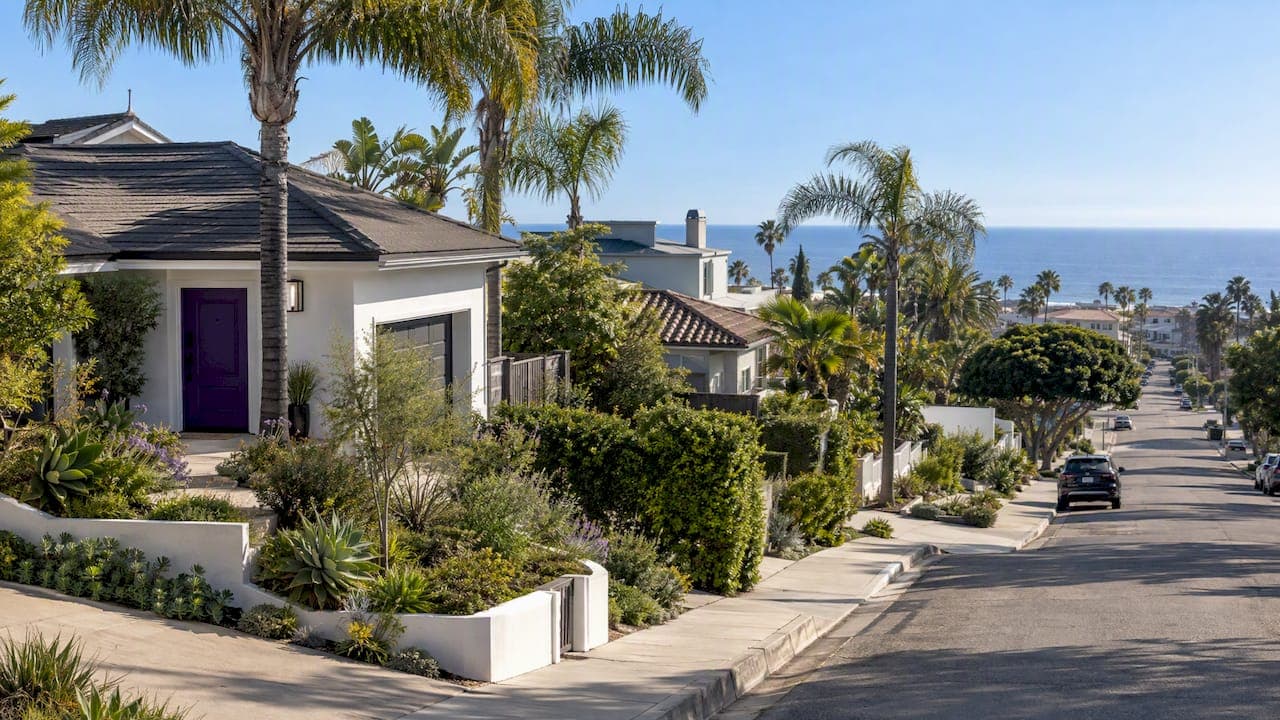
Living in Carlsbad means a small-town beach feel, strong schools, parks and trails, and a housing market that asks a lot of you. The median owner-occupied home is valued at $1,257,000, and the median household earns $142,748. If you can make those numbers work, you get one of the most polished coastal cities in North County San Diego. If you can't, Oceanside and Vista offer very different trade-offs, and we cover both below.
TL;DR
- Carlsbad's median owner-occupied home value is $1,257,000 (Census, 2020–2024), against $770,300 in Oceanside.
- About 62.9% of homes are owner-occupied, and median gross rent is $2,808 a month.
- Residents are educated and affluent: 62.1% of adults 25 and older hold a bachelor's degree or higher.
- Oceanside is the value play on the coast, and Vista trades beach access for more space.
- Decide on commute, lot size and monthly cost before you pick a city, not after you fall for a house.
Table of Contents
- What it's like to live in Carlsbad
- What it costs to live in Carlsbad
- Neighborhoods and how to choose between them
- Getting around: commuting, trains and the airport
- What to know before you move
- Living in Oceanside, the next city south
- Oceanside vs. Vista vs. Carlsbad
- Our perspective: who Carlsbad is right for
- How we help if you're moving to Carlsbad
- FAQ
- Sources
What it's like to live in Carlsbad
The city's own service plan describes a small-town beach community where residents use city programs and events, parks, trails, open space, libraries and arts. That matches how most people describe daily life: family-centered, tidy, active outdoors, and busy on weekends when beachgoers and golfers arrive.
The Census Bureau counted 114,746 residents in 2020, and its July 2025 estimate is 112,260. So this is a city of roughly 112,000 people, not a sprawling one. About 18.8% of residents are 65 or older and 23.4% are under 18, which is a fairly even spread of retirees and families.
The education and income figures explain a lot about the feel of the place. In the same Census data, 96.3% of adults 25 and older graduated high school and 62.1% have a bachelor's degree or higher. Median household income for 2020–2024 was $142,748 in 2024 dollars.
Not everyone describes it as seamless. One city-comparison site notes that residents sometimes argue over politics, enforcement and traffic, which can clash with the peaceful coastal image. That's worth hearing. A city this desirable still has the usual friction of a place where many people want to live.

What the city says it provides
Carlsbad's service plan commits to maintaining 432 acres of community parks and special-use areas, 51 miles of open-space trails, two aquatic centers, four community centers, a senior center and three libraries, plus events through the year. The Chamber of Commerce adds that the city has two world-class resorts, an international theme park, and a claim to being the golf capital of the world.
If you want a quick read of what that means for your week: trails and parks are close wherever you land, and most of the city's recreation is public and free or low cost.
What it costs to live in Carlsbad
Housing is the whole story, so start there. For 2020–2024 the Census Bureau reports:
| Measure (2020–2024) | Carlsbad |
|---|---|
| Median owner-occupied home value | $1,257,000 |
| Median gross rent | $2,808 per month |
| Median monthly owner costs (with a mortgage) | $3,741 |
| Owner-occupied housing rate | 62.9% |
| Median household income (2024 dollars) | $142,748 |
All of those come from Census QuickFacts for Carlsbad.
Two things to read carefully. First, these are medians across all homes, including older ones bought years ago. Owner costs of $3,741 reflect many mortgages taken out at lower prices. A buyer today will usually face higher monthly costs than that figure suggests. Second, the home value is a Census survey estimate across a multi-year window, not a current list price. Current asking prices shift month to month, and our own Carlsbad housing market breakdown looks at where prices diverge by area and home type.
The city is frank about the strain. Its October 2024 housing document estimates the cost of living at about 97% above the national average and calls affordability a major challenge, with desirability and limited supply driving the problem for both residents and local employers.
Renting first versus buying
With median rent at $2,808 a month, some newcomers rent for six to twelve months before buying. That is a reasonable way to learn which part of the city suits you. The cost is that you pay rent while prices and rates move. If you already know you're staying, a buyer's agent can narrow the search so you don't spend months touring the wrong areas.
Neighborhoods and how to choose between them
Carlsbad is long and narrow, running from the coast inland, and the experience changes as you move east. We'd frame the choice around four questions rather than a list of names.
- How close to the water do you need to be? Coastal and village-area homes sit near the beach, restaurants and the train. Prices there usually run higher per square foot, and lots are often smaller.
- Do you want to walk places? The village area is the most walkable. Farther inland, you'll drive for most errands.
- How much house and yard do you want? Inland parts of the city generally offer more space and newer-style planned communities.
- Which school and commute pattern fits? Schools are a strength citywide, according to the Chamber of Commerce, but boundaries matter for your specific address, so verify with the district before you make an offer.
Our Carlsbad area page walks through the parts of the city and the homes we see in each. For the wider coastal picture, see beach communities in San Diego, which compares how different beach towns live day to day.
Getting around: commuting, trains and the airport
Carlsbad sits in the middle of North County. The Chamber describes a commuter train, great bus service and the busiest single-runway airport in the nation. The Census Bureau puts the mean travel time to work at 27.1 minutes for workers 16 and older in 2020–2024.
That average hides a lot. A remote worker or someone employed in the city's own business parks has an easy day. Someone driving to downtown San Diego or toward Orange County should test the drive at the hours they'll actually make it. Do it on a weekday, not on a Sunday house tour.
What to know before you move
A few current city items are worth reading, because they affect how daily life feels.
- Aging and livability. The city launched its Age-Friendly Carlsbad project in 2020 with the AARP Livable Communities Initiative, covering outdoor spaces, housing, mobility and community connections. If you're moving here to retire, or bringing parents, that plan shows where the city is putting effort.
- Bikes and school safety. In late 2025 the city described e-bike safety measures, including a minimum age of 12, traffic-calming plans for the Barrio, and safety improvements near Kelly Elementary. Families with teens on e-bikes should read the current rules.
- Public-space rules. The same city update says Carlsbad runs a vehicle outreach program connecting people living in vehicles to services and housing, while enforcing laws against overnight camping in public spaces.
Living in Oceanside, the next city south
Many people who search for Carlsbad end up looking at Oceanside, and for good reason. Oceanside is bigger, with a listed 2026 population of 174,340, 3.5 miles of public beaches, a 1,954-foot pier and a public marina. Interstate 5 runs through the city.
The price gap is the main draw. The Census shows a median owner-occupied home value of $770,300 in Oceanside against $1,257,000 in Carlsbad, and median household income of $97,737 against $142,748 for 2020–2024. That is a difference of $486,700 in median home value. Income is lower too, so Oceanside is cheaper, not cheap.

Transit is a real advantage. A local moving guide describes Oceanside as a North County transit hub with the Coaster commuter rail, plus Amtrak, Metrolink and the Sprinter line running inland to Escondido. The same guide describes South Oceanside, known as South O, as a trendy, walkable coastal neighborhood that has drawn younger professionals and families.
The market view of the city is that it's a value play for buyers priced out of Southern California coastal markets, and that revitalization is turning it into a destination rather than a pass-through. You can see how we describe it on our Oceanside area page.
Oceanside vs. Vista vs. Carlsbad
Vista sits inland of both. One North County moving guide frames the choice as coast versus inland: coastal cities like Carlsbad and Oceanside give you milder temperatures and a beach-centered lifestyle, with higher costs and denser housing, while inland areas like Vista give you more space, larger lots and single-family homes at lower prices.
| Carlsbad | Oceanside | Vista | |
|---|---|---|---|
| Best for | Polished coastal living, schools, parks | Beach access at a lower price point, transit | Space, bigger lots, single-family homes |
| Median home value (Census, 2020–2024) | $1,257,000 | $770,300 | Check current Census data |
| Median household income (2020–2024) | $142,748 | $97,737 | Check current Census data |
| Main trade-off | Cost | Mixed neighborhoods, I-5 split | Farther from the water |
We left the Vista figures out of the table on purpose: we'd rather you pull the current Census page than rely on a number we haven't checked. The practical advice is to choose your constraint first. If it's the beach, compare Carlsbad and Oceanside block by block. If it's square footage, look at Vista and inland Oceanside before you stretch for a coastal address.
Our perspective: who Carlsbad is right for
We've worked San Diego County for more than two decades, and Carlsbad is a place where buyers often fall in love first and run the numbers second. We'd reverse that order.
Carlsbad is right for you if you value schools, parks, a strong sense of community and a clean, well-kept city, and if the monthly cost fits comfortably. It's harder if you're stretching to the top of your budget. A house you can only just afford leaves no room for repairs, insurance changes or a move in rates.
We often tell buyers to price three scenarios side by side: a smaller home in Carlsbad, a larger home in Oceanside, and a yard-heavy home in Vista. Run the full monthly payment on each, then drive each commute at rush hour. The answer is usually clearer after that than after ten open houses.
And if you're selling a home elsewhere in San Diego to move north, timing matters. Line up your valuation before you start touring, so you know what you can spend.
— Jeff
How we help if you're moving to Carlsbad
If you're buying in North County, our Buy With Confidence service covers the process from first showing through closing, with local market analysis and neighborhood guidance. If you want listings matched to your criteria as they come up, our VIP Home Search sends personalized options. Selling to fund the move? Start with a home valuation.

Tell us your budget, your commute and what you can't compromise on, and we'll tell you honestly whether Carlsbad, Oceanside or somewhere else fits.
FAQ
Is Carlsbad a good place to live?
For many people, yes. The city plan describes a small-town beach community with extensive parks, trails and libraries, and Census data show high education levels and household income. The main drawback is cost, since housing affordability is described as a major challenge in the city's own housing document.
How much do you need to earn to live in Carlsbad?
There is no single answer, because it depends on your down payment, rates and debts. For reference, median household income is $142,748 and median owner costs with a mortgage are $3,741 a month (Census, 2020–2024). Ask a lender for a pre-approval based on your own finances before you set a budget.
Is Oceanside cheaper than Carlsbad?
On the numbers, yes. The Census shows a median home value of $770,300 in Oceanside against $1,257,000 in Carlsbad for 2020–2024. Oceanside's median household income is also lower, at $97,737.
Should I choose Oceanside or Vista?
It depends on whether the beach or the space matters more. Oceanside gives you coastline, a pier and rail transit. Vista, inland, generally offers larger lots and single-family homes at lower prices, according to regional moving guides.
How long is the commute from Carlsbad?
The mean travel time to work for Carlsbad workers is 27.1 minutes (Census, 2020–2024). Your own commute depends on where you work and when you drive, so test it at your real hours before you buy.
Sources
- Carlsbad city service plan, 2023–2027
- U.S. Census Bureau QuickFacts: Carlsbad city, California
- Census QuickFacts: Carlsbad population estimate
- Census QuickFacts: Oceanside and Carlsbad comparison
- City of Carlsbad housing document, October 2024
- Carlsbad Chamber of Commerce: About Carlsbad
- Age-Friendly Carlsbad Action Plan
- City Manager's Update, December 18, 2025
- City of Oceanside: Oceanside at a Glance
- Living in Carlsbad: pros, cons and what locals say
- Moving Guide to Oceanside, CA
- Moving to North County San Diego: Which Town?
- Moving to North County San Diego: Coast vs. Inland Guide