
A closing statement is the final financial document prepared at the completion of a U.S. real estate transaction, listing every debit and credit for both the buyer and seller so the numbers reconcile to a single bottom line. According to Investopedia, standard line items include:
- Purchase price — the agreed sale amount
- Loan amount — what the lender is funding (buyer side)
- Earnest money deposit — applied as a credit toward the buyer's costs
- Prorations — property taxes, HOA dues, and prepaid items split by closing date
- Title insurance and escrow fees — paid to the title/settlement company
- Real estate commissions — typically deducted from seller proceeds
- Recording fees and transfer taxes — government charges to record the deed
The document goes by several official names depending on transaction type: the Closing Disclosure (required under TRID for most mortgage-financed purchases), the HUD-1 Settlement Statement (still seen in some cash and legacy transactions), or simply a "settlement statement" prepared by the escrow company. All three serve the same core purpose — making the math of the deal transparent and final before anyone signs.
Key Takeaways
A closing statement is the final financial document that reconciles every debit and credit in a real estate transaction, and verifying it against your original estimates before signing is the single most effective way to protect your money.
| Point | Details |
|---|---|
| Core definition | A closing statement itemizes all debits and credits for buyer and seller, resolving to cash to close or net proceeds. |
| TRID timing rule | Financed buyers must receive the Closing Disclosure at least three business days before closing. |
| Top verification step | Compare the Closing Disclosure line by line against your Loan Estimate to catch fee increases outside CFPB tolerance limits. |
| Document name variations | "Closing statement," "settlement statement," and "HUD-1" are often used interchangeably; the official federal form for most financed purchases is the Closing Disclosure. |
| Jeffsellssandiego | Works with San Diego buyers and sellers to review preliminary closing statements and resolve errors before signing day. |
Table of Contents
- What does a closing statement include, line by line?
- Who prepares the closing statement, and when will you get it?
- How do you read and verify a closing statement before signing?
- An annotated sample closing statement
- How does a closing statement differ from a settlement statement, HUD-1, and Closing Disclosure?
- What does "closing statement" mean in a courtroom?
- Where can you get your closing statement?
- What San Diego closings actually look like
- The part of closing statements most people get wrong
- Jeffsellssandiego helps you close with confidence
- Sources
What does a closing statement include, line by line?
Buyers and sellers see different versions of the same transaction, and understanding each side prevents surprises at the table.
Buyer's side centers on cash to close: how much money you need to wire or bring. The purchase price is your largest debit. Against it, the lender's loan amount and your earnest money deposit appear as credits, reducing what you owe. Then come the costs layered on top: loan origination fees, discount points, underwriting charges, prepaid homeowner's insurance, and the initial escrow impound for property taxes. Title insurance (lender's policy) and escrow fees round out the typical buyer charges. Recording fees are usually modest but vary by county.
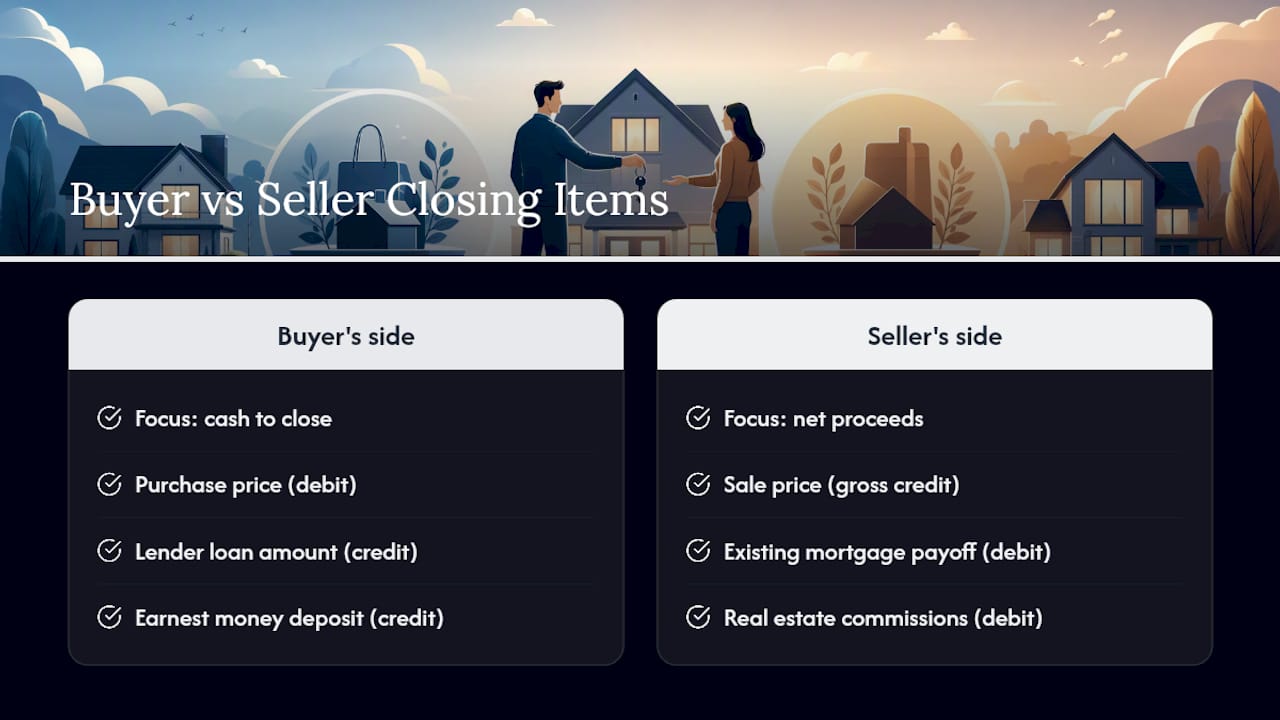
Seller's side works in reverse. The sale price is your gross credit. From it, the settlement agent subtracts your existing mortgage payoff, real estate commissions, your share of prorations, transfer taxes, any seller-paid closing costs you agreed to cover, and title fees. What remains is your net proceeds.
Prorations deserve a closer look because they trip people up. If you close mid-month, property taxes and HOA dues get split at the closing date. A seller who has already paid a full quarter of property taxes gets a credit back; a buyer who owes taxes from the closing date forward gets a debit. The math is straightforward once you know the daily rate, but an incorrect proration date is one of the most common errors on a final statement.

Who prepares the closing statement, and when will you get it?
The answer depends on whether the transaction is financed or cash, and which party you are.
For financed buyers, the lender prepares the Closing Disclosure under TRID (the TILA-RESPA Integrated Disclosure rule). Federal rules require the lender to deliver it at least three business days before consummation. That window exists so you can compare it against your original Loan Estimate and flag discrepancies before you're sitting at the signing table. Missing that window is a red flag.
For sellers, the title or escrow company prepares a seller's settlement statement or net sheet. There is no federal three-day rule for the seller's document, though a competent escrow officer will share a preliminary version a day or two before closing.
For cash transactions, there is no lender and no Closing Disclosure. The title or escrow company prepares a settlement statement for both parties, often still called a HUD-1 in practice, though that form was officially replaced for most transactions in 2015.
- Lender sends Closing Disclosure: at least 3 business days before closing (TRID transactions)
- Title/escrow sends seller net sheet: typically 1–2 days before closing
- Cash deal settlement statement: prepared by title/escrow, timing varies by company
- Final signed copies: available from the title company or lender after closing
Pro Tip: Request a preliminary closing statement as soon as escrow has all the payoff figures. Reviewing it 48–72 hours before closing gives you time to catch errors without delaying the transaction.
How do you read and verify a closing statement before signing?
Errors appear more often than most buyers and sellers expect. Reviewing the document yourself, line by line, takes about 20 minutes and can save real money.
- Start at the summary. Find the "Cash to Close" line (buyer) or "Net Proceeds" line (seller). That single number is what you're verifying everything else against.
- Check the basics. Confirm your name, the property address, and the closing date are correct. A wrong date shifts every proration calculation.
- Compare to your Loan Estimate. For buyers, the Closing Disclosure must mirror the Loan Estimate within tolerance limits set by CFPB rules. Loan origination charges cannot increase at all; other fees have a 10% tolerance. Any increase outside those bands is a violation.
- Verify the purchase price and earnest money. Both should match your purchase agreement exactly.
- Check every proration. Confirm the effective date used and calculate the daily rate yourself if needed. Property tax prorations are based on the county's assessed value and the number of days each party owns the property.
- Confirm the payoff amount. Sellers should request a payoff statement from their lender before closing and compare it to what appears on the settlement statement. Payoff figures change daily with accruing interest.
- Scan for duplicate fees. Title fees, escrow fees, and recording charges occasionally appear twice due to data-entry errors.
Common red flags to watch for:
- A commission percentage that doesn't match your listing agreement
- Escrow impound amounts that seem too high or too low
- Transfer taxes calculated on the wrong price
- Missing seller concessions you negotiated in the contract
- Loan fees that weren't on the Loan Estimate
If you spot an error, contact the escrow officer or lender immediately and ask for a corrected statement in writing. For disputes that can't be resolved before closing, a holdback or escrow arrangement can allow the transaction to close while the contested amount is held pending resolution.
Pro Tip: Keep a copy of your purchase agreement, Loan Estimate, and any addenda next to you while reviewing. Cross-referencing takes minutes and catches the majority of errors before they become post-closing headaches.
An annotated sample closing statement
The numbers below are hypothetical but representative of a mid-range San Diego transaction. They show how individual line items reconcile to cash to close and net proceeds.
A few things to notice here. The buyer's cash to close is the purchase price plus all buyer-side costs, minus the loan and earnest money. The seller's net proceeds are the gross sale price minus the mortgage payoff, commissions, escrow fees, and prorations. If the seller had also agreed to a $5,000 repair credit, that debit would appear on the seller side and reduce net proceeds to $409,400 — a single line item with a real dollar impact.
For local context on how closing costs in Point Loma compare to county averages, the numbers can shift meaningfully by neighborhood.
How does a closing statement differ from a settlement statement, HUD-1, and Closing Disclosure?
The terms overlap, and the confusion is understandable. Here is the practical distinction.
Closing statement is the colloquial umbrella term. It refers to any final financial summary document at a real estate closing. Investopedia notes that "closing statement" and "settlement statement" are often used interchangeably, though official names vary by transaction type and region. The Cambridge English Dictionary also recognizes "completion statement" as a U.S. lexical variant for the same document.
HUD-1 Settlement Statement was the standard federal form for most real estate closings before October 2015. You will still encounter it in reverse mortgage transactions and some cash deals where lenders choose to use it.
Closing Disclosure replaced the HUD-1 for most mortgage-financed purchases under TRID. It is a five-page federal form prepared by the lender, not the title company, and it carries the three-business-day delivery requirement.
Settlement statement prepared by the title or escrow company covers the seller's side and cash transactions. It is not a federal form and its format varies by company and state.
State-specific variations matter too. In California, escrow companies handle closings rather than attorneys, which affects who prepares the seller's statement and how fees are itemized. In attorney-closing states like New York or Massachusetts, a real estate attorney prepares and reviews the settlement statement. Investor transactions and refinances have their own document variations as well.
- Cash sales: title/escrow settlement statement, no Closing Disclosure
- Financed purchases: Closing Disclosure (lender) plus escrow settlement statement
- Reverse mortgages: HUD-1 still applies
- Refinances: Closing Disclosure from the lender, no seller statement
What does "closing statement" mean in a courtroom?
The term has a second, entirely different meaning in legal proceedings. A courtroom closing statement, more precisely called a closing argument, is a lawyer's final opportunity to explain how the evidence supports their client's position. According to the Legal Information Institute at Cornell Law, it is rhetorical and persuasive by nature, not a financial document.
The American Bar Association notes that closing arguments must stay within the evidence already presented at trial. Judges typically instruct counsel on limits before arguments begin, and objections during closings are rarely sustained, though preserving them matters for appeals.
Key distinctions from the real estate meaning:
- A courtroom closing statement introduces no new evidence
- It is a persuasive summary of admitted facts, not a financial accounting
- Its power comes from framing, not from new information
- Wikipedia's entry on "closing statement" captures both meanings, which is why context matters when you encounter the term
Where can you get your closing statement?
Buyers receive the Closing Disclosure from their lender, typically by email or through a secure portal, at least three business days before closing. After closing, the signed copy is available from both the lender and the title company.
Sellers receive their settlement statement from the title or escrow company. Request a preliminary version as soon as the escrow officer has the payoff figure from your lender. Final signed copies come from the title company after closing.
- To request a copy post-closing: contact your title/escrow company first; lenders also retain Closing Disclosures
- Have your purchase agreement and a government-issued ID ready when requesting documents
- Keep your closing statement for at least three years for tax purposes; capital gains calculations and deductible closing costs depend on it
- If you need a corrected statement, submit the request in writing to the escrow officer and copy your agent
For buyers navigating San Diego's market, the Buyer's Guide at Jeffsellssandiego walks through every step from offer to closing, including what to expect on the Closing Disclosure.
What San Diego closings actually look like
San Diego transactions have a few quirks that catch clients off guard. Property tax prorations here are calculated on the fiscal year (July 1 through June 30), not the calendar year, so a closing in March means the proration math looks different than buyers expect from online calculators built for other states. Escrow fees in San Diego are also typically split 50/50 between buyer and seller, but that split is negotiable and sometimes shifts in a competitive market. The line item that surprises sellers most often is the county transfer tax: $1.10 per $1,000 of sale price, plus any city transfer tax if the property is within San Diego city limits. On a higher-value sale, that adds up fast. Reviewing the preliminary closing statement with clients before they sign is one of the most concrete things an agent can do — not to provide legal advice, but to flag numbers that don't match the contract so the escrow officer can correct them before closing day.
For more on how escrow fees in San Diego break down for buyers and sellers, that resource covers the specifics by transaction type.
The part of closing statements most people get wrong
Most guides tell you to "review your closing statement carefully." That advice is correct but incomplete. The real issue is knowing what you're comparing it against.
A closing statement does not exist in isolation. It is the final version of a financial story that started with the purchase agreement, continued through the Loan Estimate, and ended here. Every number on it should trace back to a document you already signed or a calculation you can verify. When buyers treat the Closing Disclosure as a standalone document, they miss the comparison that actually catches errors: the Loan Estimate side by side.
Sellers have the same blind spot. A seller net sheet prepared early in the transaction is an estimate. The final settlement statement is the truth. The gap between them is where surprises live: a payoff figure that accrued more interest than expected, a commission split that changed, a repair credit that was added in a counter-offer and then forgotten. Agents who walk clients through the preliminary statement before closing day are not being overly cautious. They are doing the job.
Jeffsellssandiego helps you close with confidence
Closing statements are where the entire transaction becomes real numbers. If a line item doesn't match your contract, or a fee appears that nobody explained, you need someone who knows what to look for and who to call.

Jeffsellssandiego works with buyers and sellers across San Diego County, reviewing preliminary closing statements before signing day, coordinating with escrow officers to correct errors, and making sure the final numbers match what was negotiated. Whether you're buying your first home or selling to move up, having an agent who reads the fine print is the difference between a smooth close and a post-closing dispute.
Ready to start? Search available homes in San Diego, or visit the Seller's Guide to understand your net proceeds before you list.
Sources
- What Is a Closing Statement? Definition and Examples
- closing argument | Wex | US Law | LII / Legal Information Institute
- How Courts Work
- COMPLETION STATEMENT definition | Cambridge English Dictionary
- Closing statement
This article is general information, not a substitute for advice from a qualified financial advisor. Consult a qualified financial professional about your own circumstances before acting on anything here.