
If you're buying or selling a primary residence in San Diego, hire a licensed local residential agent and interview a few candidates before signing anything. A good agent brings market knowledge, contract expertise, and negotiation skill you can't replicate solo. Verify the license first, then schedule tours.
TL;DR:
- Verify a San Diego agent's license through the DRE lookup tool to ensure authority and avoid risky representations.
- Ask detailed questions about recent local transactions, marketing plans, and negotiation experiences to assess an agent’s competence.
- Avoid agents who promise high listing prices upfront or pressure you to sign agreements before all questions are answered.
- Be prepared for a typical 30-day escrow timeline with key costs settling during contingencies, requiring experienced guidance to manage risks.
- Use a qualified intermediary for 1031 exchanges, paying close attention to deadlines and state-specific rules to prevent disqualification.
Table of Contents
- Full-Service San Diego Agents: What You're Actually Paying For
- How Do You Choose the Right Agent in San Diego?
- What Does the Timeline and Cost Actually Look Like?
- How Jeff Helps San Diego Buyers and Sellers
- Your Preclosing Checklist: What to Do This Week
- What a 1031 Exchange Actually Does for Property Owners
- California's Rules Layer on Top of the Federal Framework
- Which San Diego Properties Actually Qualify
- Why a Qualified Intermediary Isn't Optional
- The Two Clocks You Cannot Miss
- Where 1031 Exchanges Go Wrong
- What This Guide Gets Right That Most Hiring Advice Misses
- Ready to Talk to a San Diego Agent Directly?
- Sources
Full-Service San Diego Agents: What You're Actually Paying For
A San Diego residential agent's real work happens before you ever set foot in a house. Anyone can open a map app and drive around neighborhoods. What you're paying for is everything that happens behind the scenes.
Agents who work full-time in this market check new listings daily and often hear about homes before they hit the public sites, through relationships with other agents, brokers, and property managers. That head start matters in a county where desirable listings in neighborhoods like North Park or Kensington can draw multiple offers within days.
Before an offer ever gets written, a competent agent pulls comparable sales, walks through seller disclosures line by line, and coordinates with your lender so financing doesn't stall the deal at the worst possible moment. On the seller side, the job looks different but is just as involved: pricing strategy, professional photography, staging recommendations, and a marketing push aimed at the buyers most likely to actually want that specific house.
The negotiation piece is where experience shows up most. An agent who understands how appraisers value a property and where recent comps sit can keep you from overpaying in a bidding war, a real risk in competitive submarkets where emotion tends to push offers past what the numbers support.
Here's what full service typically includes:
- Daily monitoring of new and off-market listings in your target neighborhoods
- Comparative market analysis before you write or accept an offer
- Full disclosure review and lender coordination through closing
- Professional marketing, photography, and staging guidance for sellers
- Negotiation grounded in appraisal data, not guesswork
Pro Tip: Ask a prospective agent to walk you through a recent deal that got complicated. How they solved that problem tells you more than any polished sales pitch ever will.
How Do You Choose the Right Agent in San Diego?
Start by confirming the agent is actually licensed and in good standing. You can verify an agent's license and disciplinary history directly through the California Department of Real Estate's public lookup tool before you agree to anything. It takes less than five minutes and it's the single most important step people skip.
Once the license checks out, move to the interview. Talk to multiple agents rather than defaulting to the first one a friend recommends. California's own consumer guidance recommends researching each agent, asking for references, and confirming they work under a licensed broker.
Useful questions to ask during that interview:
- How many transactions have you closed in this specific neighborhood in the past year?
- What's your marketing plan if I'm selling, or your search strategy if I'm buying?
- Can you walk me through a recent negotiation that didn't go as planned?
- How is your compensation structured, and is it negotiable?
- Will you put our agreement in writing before we tour or list any property?
Watch for warning signs. Industry guidance specifically warns against agents who promise an unrealistically high listing price just to win your business, then quietly lower it once you're locked in. Other red flags:
- Vague answers about specific neighborhoods or recent local sales
- Reluctance to explain how they get paid or negotiate their compensation
- Pressure to sign an agreement before you've asked a single question
- No written agreement offered at all
That last point matters more than it used to. Buyer representation agreements now need to be in writing, and California law changes taking effect around 2025 require clearer compensation disclosure up front. Read that agreement before you tour a single home, not after.
What Does the Timeline and Cost Actually Look Like?
Most San Diego residential transactions follow a predictable rhythm once an offer is accepted, even if the weeks leading up to that offer can stretch on unpredictably in a tight market.
After your offer is accepted, expect roughly this sequence:
- Days 1 to 3: Offer acceptance and opening of escrow
- Days 3 to 17: Inspection and appraisal contingency period
- Days 17 to 21: Loan contingency and final lender approval
- Days 21 to 30: Closing and funding
A standard escrow in San Diego often runs close to 30 days, though cash deals can close faster and financed deals with appraisal issues can run longer.
Costs show up at predictable points too. Escrow and title fees, home inspection costs, and any negotiated repair credits typically get settled during the contingency period, while agent compensation and remaining closing costs are finalized at settlement. In a hot submarket, tight inventory can compress your shopping window and push buyers toward waiving certain contingencies. That's exactly where an experienced agent earns their keep, helping you decide which risks are worth taking and which aren't.
How Jeff Helps San Diego Buyers and Sellers
An experienced San Diego agent handles negotiation and disclosure work that determines whether a deal actually closes cleanly.
Two recent listings show that work in practice:
- The 3625-27 29th St listing in North Park involved detailed local market analysis to position the property against comparable sales in a neighborhood where pricing swings block to block.
- A Sagebrush Bend Way transaction required close coordination on disclosures and timeline management to keep the sale on track through closing.
Most of what determines whether a San Diego transaction closes smoothly happens in the parts buyers never see: the disclosure review, the lender calls, the comps pulled before an offer goes in. Touring homes is the easy part.
Readers preparing for their own transaction can review the client's preclosing checklist and transfer tax guide for a practical breakdown of what to expect before closing day.
(Client testimonials, certifications, and case studies to be added.)
Your Preclosing Checklist: What to Do This Week
Once you've decided to move forward, the sequence matters. Do these roughly in order:
- Verify your prospective agent's license through the DRE lookup tool
- Get preapproved for a mortgage before you start touring, or get your home valuation started if selling
- Draft your interview questions and schedule conversations with 2 to 3 agents
- Ask each agent for a sample marketing plan or search strategy specific to your target neighborhood
- Review and sign a written representation agreement only after your questions are answered
- Gather financial and identification documents your lender or escrow company will need
For buyers ready to start looking, the San Diego property search page and the 2026 buying and selling guide are good starting points.
| Week | What Happens |
|---|---|
| Week 1 | Verify license, interview agents, sign agreement |
| Week 2 to 3 | Active search or listing goes live |
| Week 4 | Offer accepted, escrow opens |
| — | Contingencies clear, closing completes |
What a 1031 Exchange Actually Does for Property Owners
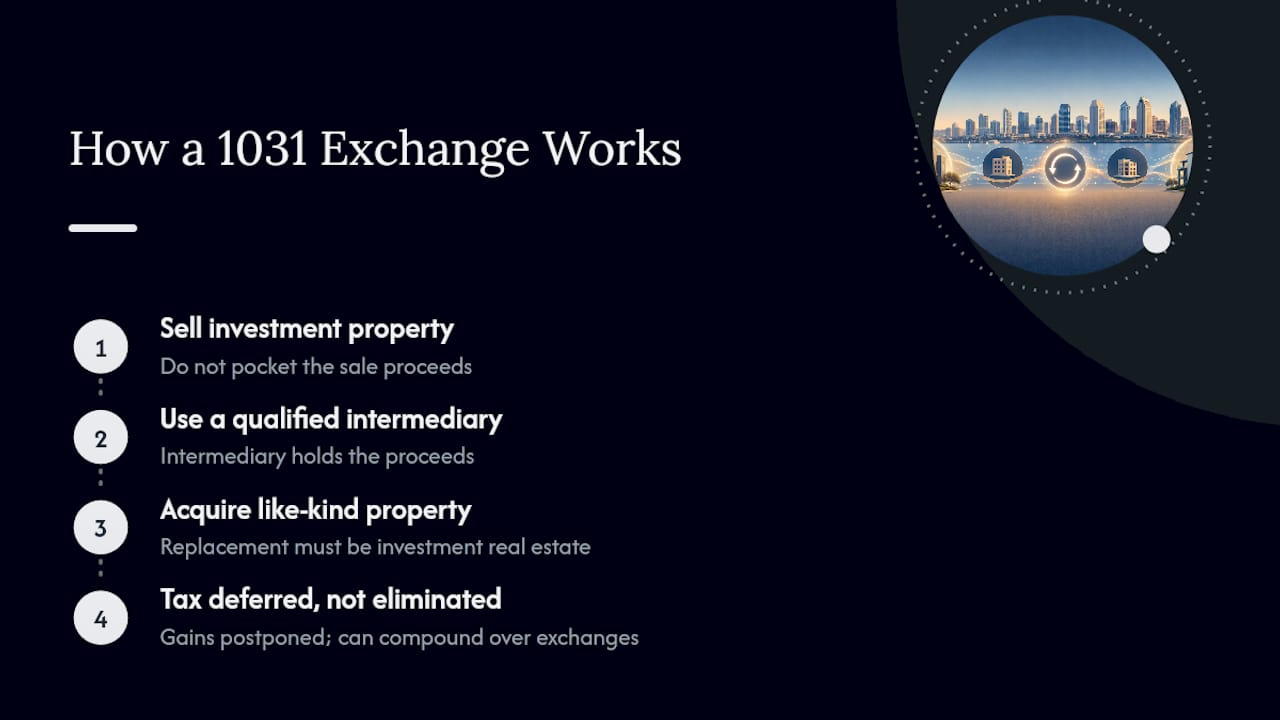
A 1031 exchange, named for Section 1031 of the federal tax code, lets an owner of investment or business property sell it and reinvest the proceeds into a similar property while deferring capital gains tax on the sale. The tax isn't eliminated. It's postponed, sometimes indefinitely if the owner keeps exchanging into new properties rather than cashing out.
The appeal is straightforward: instead of losing a chunk of your equity to taxes at the point of sale, that money stays working in your next property. Over multiple exchanges, that deferred tax can compound into meaningfully more buying power than a series of taxed sales would produce.
This only applies to property held for investment or business use, not the home you live in day to day. Someone selling a rental property or a small apartment building might use this strategy to move into a different property, a different neighborhood, or a different property type entirely, without triggering an immediate tax bill.
The exchange has to follow a specific structure. The properties involved must be "like kind," meaning both are real property held for investment purposes, and the transaction has to run through a qualified intermediary rather than the seller simply pocketing the proceeds and repurchasing later. Get any part of that structure wrong, and the tax deferral disappears.
California's Rules Layer on Top of the Federal Framework
California generally follows the federal 1031 framework, but the state adds its own wrinkle that trips up out-of-state investors constantly: the "clawback" rule.
If a California property owner exchanges into a replacement property located outside California, the state doesn't forget about that deferred gain. Once the replacement property is eventually sold, California requires the owner to report and pay state tax on the original deferred gain, even if that final sale happens in another state entirely. The Franchise Tax Board tracks this through an annual information return that has to be filed every year the gain remains deferred.
That reporting requirement isn't optional and it isn't a one-time form. Skip a year, and California can disqualify the deferral treatment retroactively.
For property owners exchanging within California, the state rules mirror federal timing and structure closely. The real complexity shows up specifically when a San Diego property owner is tempted to exchange into an out-of-state replacement property, chasing lower prices or higher cap rates elsewhere. That can still work, but it requires ongoing paperwork that a lot of owners don't realize follows them for years.
Which San Diego Properties Actually Qualify
Eligibility comes down to use, not property type. Nearly any real property held for investment or business purposes can qualify, which gives San Diego investors more flexibility than most assume.
A small multifamily building in City Heights can exchange into a commercial retail space in Chula Vista. A rental condo near Pacific Beach can exchange into raw land held for future investment, or into a share of a larger commercial property through a structure like a Delaware Statutory Trust. What doesn't qualify is a primary residence, a second home used mainly for personal enjoyment, or property held primarily for resale, like a flip.
San Diego's mix of coastal condos, inland single-family rentals, and small multifamily buildings gives local investors a reasonably wide menu of both properties to sell and properties to buy into. Some investors also look at accessory dwelling unit conversions as a way to reposition a property's income potential before deciding whether to sell or exchange, a strategy outlined in more detail here for anyone weighing that route.
The safest test: if the property has been generating rental income or held as a business investment, it's likely eligible. If you or your family have been living in it as a residence, it isn't.
Why a Qualified Intermediary Isn't Optional
The IRS requires that an independent qualified intermediary hold the sale proceeds between the relinquished property's sale and the replacement property's purchase. The seller can never take direct or even temporary control of that money. Not for a day, not to cover a bridge expense, not for any reason.
This isn't bureaucratic caution. It's the mechanism that makes the "exchange" an exchange rather than a taxable sale followed by a separate purchase. A qualified intermediary is typically a company that specializes in this exact function, holding funds in escrow, preparing the exchange documentation, and disbursing money directly to the closing on the replacement property.
Choosing that intermediary matters more than most first-time exchangers realize. The intermediary can't be someone who has acted as the owner's agent, attorney, or accountant within the prior two years, which rules out a lot of obvious choices like a family CPA. Real estate agents involved in the transaction generally can't serve in this role either.
Investors typically line up their intermediary before listing the relinquished property, not after finding a buyer. Waiting too long can create a scramble that puts the entire deferral at risk if the sale closes before the intermediary structure is in place.
The Two Clocks You Cannot Miss
Every 1031 exchange runs against two deadlines that start ticking the moment the relinquished property's sale closes, and neither one bends for extenuating circumstances.
The first is the identification period: 45 calendar days from the closing date to formally identify potential replacement properties in writing to the qualified intermediary. Investors can name up to three properties regardless of value, or more than three under specific valuation rules if they're hedging across several options.
The second is the exchange period: 180 calendar days from the same closing date to actually close on the replacement property. That 180 day window includes the 45 days, not in addition to them, so an investor who uses the full 45 days to decide has 135 days left to actually close.
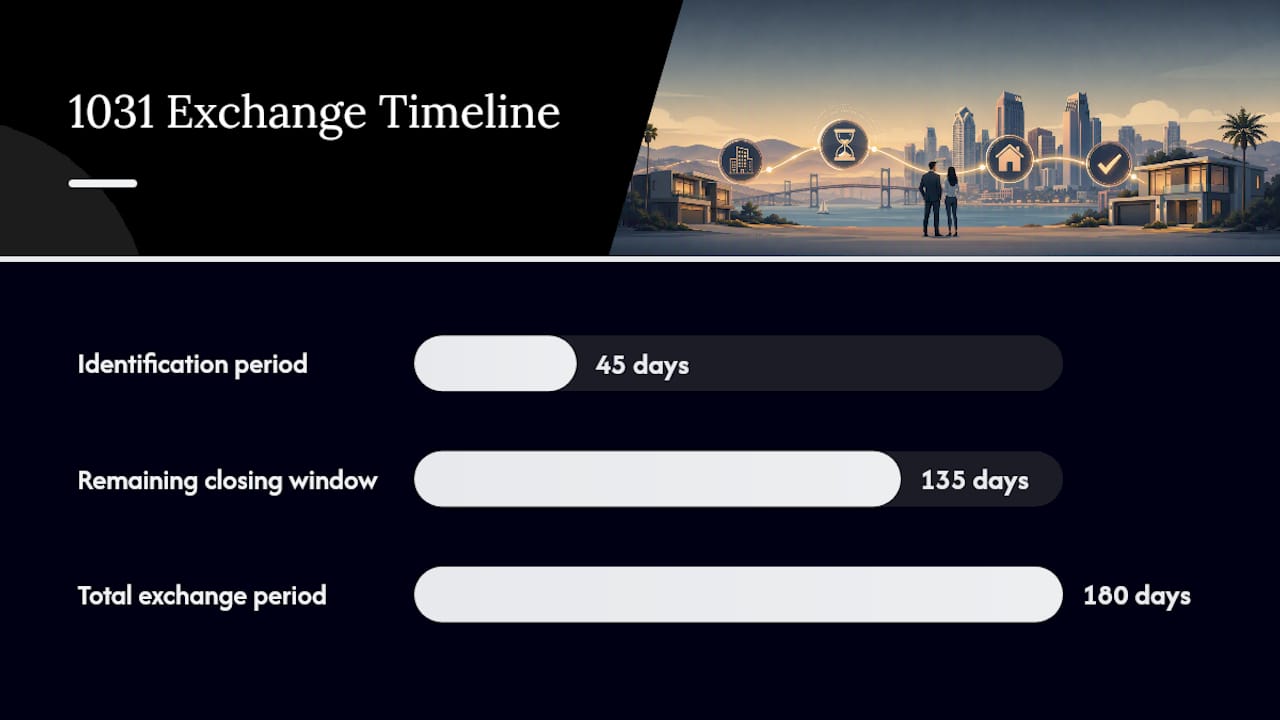
Both deadlines run on calendar days, including weekends and holidays, and neither the IRS nor a qualified intermediary has authority to extend them for routine delays like financing hiccups or a slow escrow. A San Diego investor eyeing a replacement property in a competitive submarket needs to have financing largely lined up before that clock even starts, because a deal that falls through in month five leaves almost no runway to find and close on an alternative.
Where 1031 Exchanges Go Wrong
Disqualification usually comes down to a handful of repeat mistakes, not exotic tax traps.
Missing a deadline is the most common one. Investors underestimate how fast 45 days moves, especially in a market where good replacement properties get multiple offers, and they end up with an identification list built in a panic rather than through real due diligence.
Touching the sale proceeds, even briefly, is the next most damaging error. Some sellers try to use a portion of the funds to cover an unrelated expense, intending to replace the money before the intermediary needs it. The IRS doesn't allow that kind of informal timing, and it can disqualify the entire exchange retroactively.
A few other patterns show up repeatedly:
- Identifying a replacement property that turns out not to be genuinely "like kind"
- Using an intermediary who doesn't meet independence requirements
- Underestimating the replacement property's price relative to the relinquished property, creating "boot," or leftover taxable cash
- Failing to file California's required annual tracking return for out-of-state replacement properties
Most of these failures trace back to the same root cause: treating the exchange as a real estate transaction first and a tax structure second, when it has to be planned as both from day one.
What This Guide Gets Right That Most Hiring Advice Misses
Most articles about hiring a San Diego agent treat the decision like picking a contractor: get three quotes, pick the cheapest, move on. That advice undersells what actually separates a good outcome from a bad one in this market.
The conventional wisdom overweights personality and underweights process. Charisma doesn't prevent a blown appraisal contingency or a missed disclosure deadline. What matters is whether an agent can show you, specifically, how they've handled a deal that got complicated, because every San Diego transaction eventually does.
If I had to pick one thing to prioritize first, it's the license verification step people treat as a formality. It takes minutes and it's the only step that protects you from someone operating outside their authority entirely. Everything else, the interview questions, the marketing plan review, the comp analysis, only matters once that baseline is confirmed.
The uncomfortable truth is that most buyers and sellers pick an agent the way they'd pick a restaurant: a recommendation, a nice photo, a gut feeling. In a transaction worth hundreds of thousands of dollars, that's not enough.
— Jeff
Ready to Talk to a San Diego Agent Directly?
Everything covered here, the license checks, the interview questions, the timeline math, points toward one practical next step: talking to someone who does this work daily in San Diego neighborhoods you're actually considering. Professional agents handle buyer and seller representation across San Diego, including comps, disclosure review, negotiation, and closing coordination, the same tasks outlined in the checklist above.

If you're buying, the Home Search page lets you browse current listings and request a showing directly. Sellers can start with a free home valuation to get a realistic price range before interviewing anyone. And if you want a deeper walkthrough of the buying process first, the Buyer's Guide covers the full sequence from preapproval to closing day.
(Client testimonials and reviews to be added.)