
If you're behind on your mortgage, call your loan servicer today and get the name of the person you speak with. Then call a HUD-approved housing counselor at (800) 569-4287 and the Legal Aid Society of San Diego at 1-877-534-2524, both free. Check whether a Notice of Default has been recorded on your property, because that starts a 90-day clock to act.
TL;DR:
- Opening communication with your loan servicer and local HUD counselors early can preserve more options and prevent losing leverage as the sale date approaches.
- Loan modifications, forbearance, and repayment plans can help you keep your home but require timely, organized application processes within the 90-day post-NOD window.
- Selling your home through a short sale, deed in lieu, or traditional sale often results in less credit damage and quicker resolution if you have equity and act before the trustee sale.
- Filing bankruptcy can temporarily pause foreclosure and may allow for a court-approved repayment plan, but it has long-term financial implications that require professional advice.
- Your mortgage delinquency already impacts your credit score, but a successful pre-foreclosure strategy can mitigate further damage and improve future borrowing opportunities.
Table of Contents
- What Are Your Pre-Foreclosure Options in San Diego?
- What Should You Do in the First 7 to 14 Days?
- How Does Loan Modification Actually Work?
- Should You Use Forbearance or a Repayment Plan Instead?
- When Does Bankruptcy or Legal Action Make Sense?
- Is Selling Your Home a Better Option Than Foreclosure?
- Jeff's Take: A Local Agent's Quick Decision Checklist
- How Does Pre-Foreclosure Affect Your Credit and Future Loans?
- What Is the Redemption Period and What Rights Do You Have?
- Will You Owe Taxes on a Short Sale or Loan Forgiveness?
- How Do You Talk to Your Lender to Get Real Results?
- What Local San Diego Resources Can Help You Right Now?
- Jeff's Perspective: What Most Foreclosure Advice Gets Wrong
- Need to Sell Fast? Here's How Jeff Can Help
- Where to Get Help Right Now
- Sources
- FAQ
What Are Your Pre-Foreclosure Options in San Diego?
Pre-foreclosure isn't one problem with one fix. It's a window, usually measured in weeks, where several different tools are still on the table. Some keep you in the house. Others get you out of it on your own terms instead of the bank's.
Here's the quick map:
- Loan modification: permanently changes your rate, term, or payment structure so you can afford to stay.
- Forbearance: pauses or reduces payments temporarily, usually while you sort out a short-term hardship.
- Repayment plan: spreads missed payments across future installments without changing the loan itself.
- Chapter 13 bankruptcy: uses a court-approved plan to cure arrears over three to five years.
- Chapter 7 bankruptcy: can delay foreclosure through an automatic stay but doesn't typically save the home long-term.
- Short sale: sells the home for less than what's owed, with lender sign-off.
- Deed in lieu of foreclosure: hands the property to the lender voluntarily, skipping the public sale process.
- Traditional sale: if you have equity, selling outright before a Notice of Trustee Sale is often the fastest, cleanest exit.
Retention options (modification, forbearance, repayment plans) cost you time and paperwork but preserve homeownership. Exit options (short sale, deed in lieu, traditional sale) move faster and do less damage to your credit than letting a foreclosure complete. Bankruptcy sits in between: it buys time and can retain the home, but with real long-term financial trade-offs.
What Should You Do in the First 7 to 14 Days?
The two weeks after you fall behind, or right after a Notice of Default hits the county recorder, decide how many options you'll still have. Move fast.
- Open every piece of mail from your servicer and keep copies. Ignoring notices is not a defense in foreclosure proceedings, and responding early keeps more paths open.
- Call your servicer directly. Get the representative's name and reference number, and ask in writing for a list of loss mitigation options available on your loan.
- Call the HUD counseling hotline at (800) 569-4287. These sessions are free, and counselors can help you build a modification packet that a servicer will actually accept.
- Call Legal Aid Society of San Diego intake at 1-877-534-2524 for a referral to foreclosure defense help or bankruptcy guidance.
- Gather your documents now: two months of pay stubs, your last two bank statements, a written hardship letter, and your mortgage statement history.
- Stay away from any company that calls or mails you promising to "save your home" for an upfront fee. Everything they charge for, a HUD counselor does free.
Pro Tip: Keep a simple log with dates, names, and summaries of every call to your lender. If your case ever goes to a mediation hearing or court, that log is often the single most persuasive document you can produce.
How Does Loan Modification Actually Work?
A loan modification rewrites the terms of your existing mortgage. Lenders can lower your interest rate, extend your term to shrink the monthly payment, or move a chunk of principal to the back of the loan as deferred, non-interest-bearing debt. None of that happens automatically. You have to ask, document, and often ask again.
Servicers typically want to see:
- A signed hardship letter explaining what changed (job loss, medical bills, divorce, income drop).
- Two months of pay stubs or profit-and-loss statements if self-employed.
- Recent bank statements showing your current cash position.
- A completed loss mitigation application, usually the servicer's own form.
Applying inside the 90-day post-NOD window matters. Once a trustee sale date gets set, servicers are far less willing to negotiate, and some stop reviewing modification requests altogether. FHA-insured loans have their own loss mitigation programs run through HUD channels, so check your loan type before you apply. A HUD counselor or a mortgage broker can help you figure out which program actually fits your loan.
Should You Use Forbearance or a Repayment Plan Instead?
Forbearance and repayment plans solve different problems, even though people use the terms interchangeably.
- Forbearance temporarily reduces or suspends payments, usually for a defined period, while you deal with a short-term hardship like a layoff or medical leave.
- Repayment plans take the amount you're behind and tack it onto your regular payments over several months until you're caught up.
- Forbearance works as a bridge when your income is about to recover. If it isn't, forbearance just delays a harder decision later.
- Either way, document your hardship in writing and follow up with your servicer every one to two weeks. Loss mitigation departments are slow, and files get lost.
When Does Bankruptcy or Legal Action Make Sense?
Filing bankruptcy triggers an automatic stay, a court order that immediately halts a scheduled foreclosure sale. That's the main reason people use it as a last-resort brake.
- Chapter 13 lets you propose a repayment plan to cure your arrears over three to five years, provided you have steady income to fund it.
- Chapter 7 can pause a sale temporarily through the stay but generally doesn't offer a path to keep the home long-term if you're behind.
- Call an attorney once a Notice of Default is recorded, once a sale date gets set, or once your servicer stops responding to loss mitigation requests.
- A bankruptcy attorney should coordinate with, not replace, any modification or short sale effort already underway.
Pro Tip: Bankruptcy is not a simple default fix. It can protect the house, but the long-term cost to your credit and finances needs a real conversation with counsel before you file, not after.
Is Selling Your Home a Better Option Than Foreclosure?
Selling is often the cleanest exit, and which version fits depends almost entirely on your equity position.
- Short sale: the home sells for less than the loan balance, and the lender has to approve the price and terms in advance. Depending on your loan and state rules, you may still face deficiency exposure, so get that in writing before you sign anything.
- Deed in lieu: you hand the property title directly to the lender instead of going through the sale process. Lenders generally only accept this when the property is in decent condition and a short sale attempt has already failed.
- Traditional sale: if you have equity, listing the home now, before a trustee sale date, usually nets you far more money and avoids the credit damage to a completed foreclosure.
- A local agent who knows San Diego's neighborhood-level pricing can move a listing faster and negotiate directly with your servicer's loss mitigation team, which matters when your timeline is measured in weeks. Read more on how short sales work before deciding which route fits your situation.
Jeff's Take: A Local Agent's Quick Decision Checklist
I ask every homeowner in this spot three questions: How much equity do you actually have? How many weeks until a sale date? And what do you want your life to look like in six months, keep the house or start over clean?
and shape how I answer those questions for San Diego neighborhoods specifically, where values and timelines vary block to block.
A local agent can often get a short sale or an emergency listing moving faster than a homeowner working alone, because lenders respond differently to an agent-negotiated file. If refinancing or rate relief is part of your plan, our posts on mortgage rate strategies in La Jolla and short sale basics are worth a read before you call your servicer back.
How Does Pre-Foreclosure Affect Your Credit and Future Loans?
A missed payment shows up on your credit report almost immediately, and it compounds fast. Payments 30, 60, and 90 days late each get reported separately, and each one drops your score further. By the time a Notice of Default is recorded, your credit report already reflects several months of delinquency, regardless of whether the foreclosure ever completes.
The good news: not every pre-foreclosure path ends the same way on your credit file. A loan modification that gets you current again stops the bleeding and lets your score start recovering within months. A short sale or deed in lieu reports as a settled or negotiated debt, which stings less than a completed foreclosure and typically shortens the waiting period before you qualify for another mortgage. A completed foreclosure is the worst outcome for your credit and can affect your ability to get a new FHA-backed loan for several years.
If buying again is part of your future plans, the path you choose now, modification versus short sale versus letting the process run its course, has real consequences for how soon you can walk into a lender's office and qualify again. Talk to a mortgage broker about how each option specifically affects your file, because generic credit-score advice doesn't account for loan-type quirks like FHA seasoning requirements.
What Is the Redemption Period and What Rights Do You Have?
California doesn't offer the kind of statutory post-sale redemption period some other states use, where a former owner can buy the property back after the trustee sale. Once a nonjudicial trustee sale completes in California, your right to reclaim the home through repayment generally ends. That's exactly why the pre-sale window matters so much.
What you do have is the California Homeowner Bill of Rights, a set of state protections that require servicers to give you a single point of contact, review your complete loss mitigation application before finalizing a sale date, and avoid what's called "dual tracking," pursuing foreclosure while a modification request is still under active review. If a servicer violates these protections, you may have legal grounds to delay or challenge the sale, which is exactly the kind of issue Legal Aid Society of San Diego and a local attorney can evaluate.
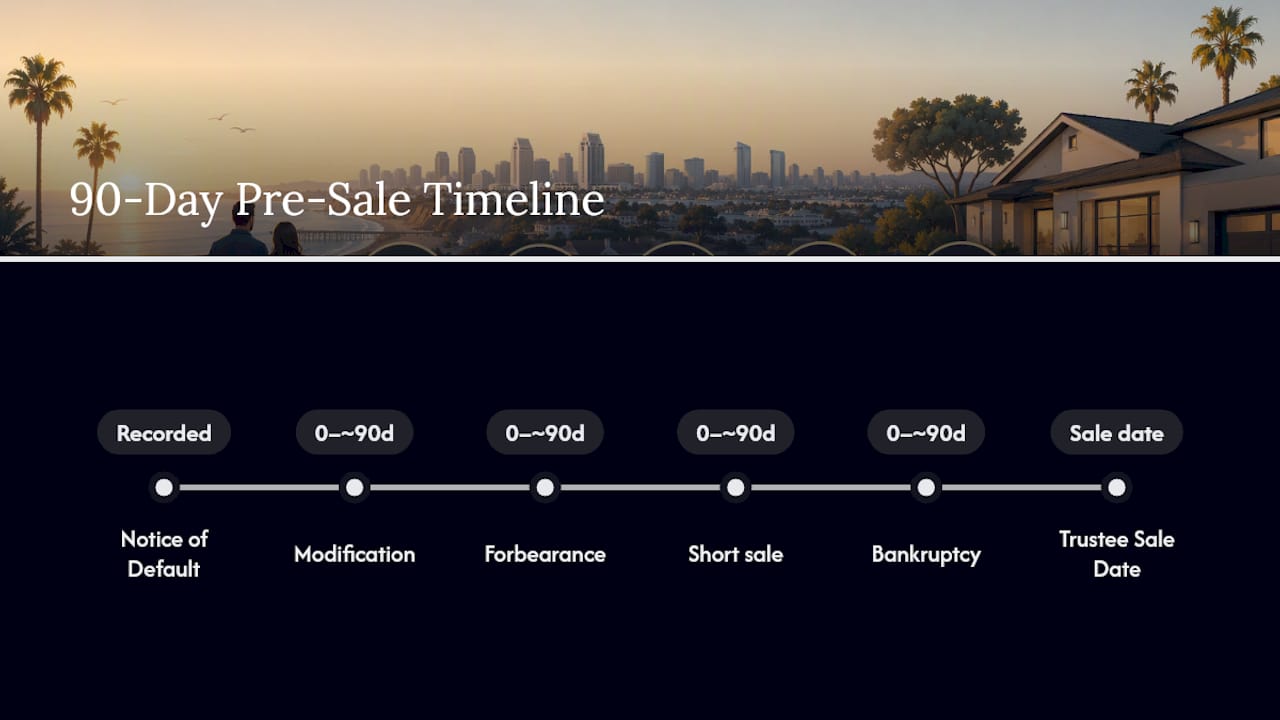
The real redemption period that matters for most San Diego homeowners isn't a legal right after the sale. It's the roughly 90 days between the recorded Notice of Default and a scheduled trustee sale date. Every option in this guide, modification, forbearance, short sale, bankruptcy, works best inside that window and gets harder, sometimes impossible, once it closes.
Will You Owe Taxes on a Short Sale or Loan Forgiveness?
When a lender forgives part of your mortgage debt, through a short sale, deed in lieu, or a loan modification with principal reduction, that forgiven amount can be treated as taxable income under federal law. The IRS generally counts cancelled debt as income unless a specific exclusion applies.
The Mortgage Forgiveness Debt Relief Act and its later extensions have, in various years, allowed homeowners to exclude forgiven mortgage debt on a primary residence from federal taxable income, though the rules and expiration dates have shifted over time. California has had its own conformity provisions that sometimes track the federal exclusion and sometimes don't. Because these rules change from year to year and depend heavily on your specific loan, whether the home was your primary residence, and how much debt gets forgiven, this is not a guess-and-hope situation.
Talk to a tax professional or CPA before finalizing a short sale or accepting a modification with principal forgiveness. The lender will typically send a Form 1099-C reporting the cancelled debt amount, and you'll need documentation showing why an exclusion applies if you're claiming one. Skipping this step is how homeowners who successfully avoid foreclosure end up blindsided by a tax bill the following spring.
How Do You Talk to Your Lender to Get Real Results?
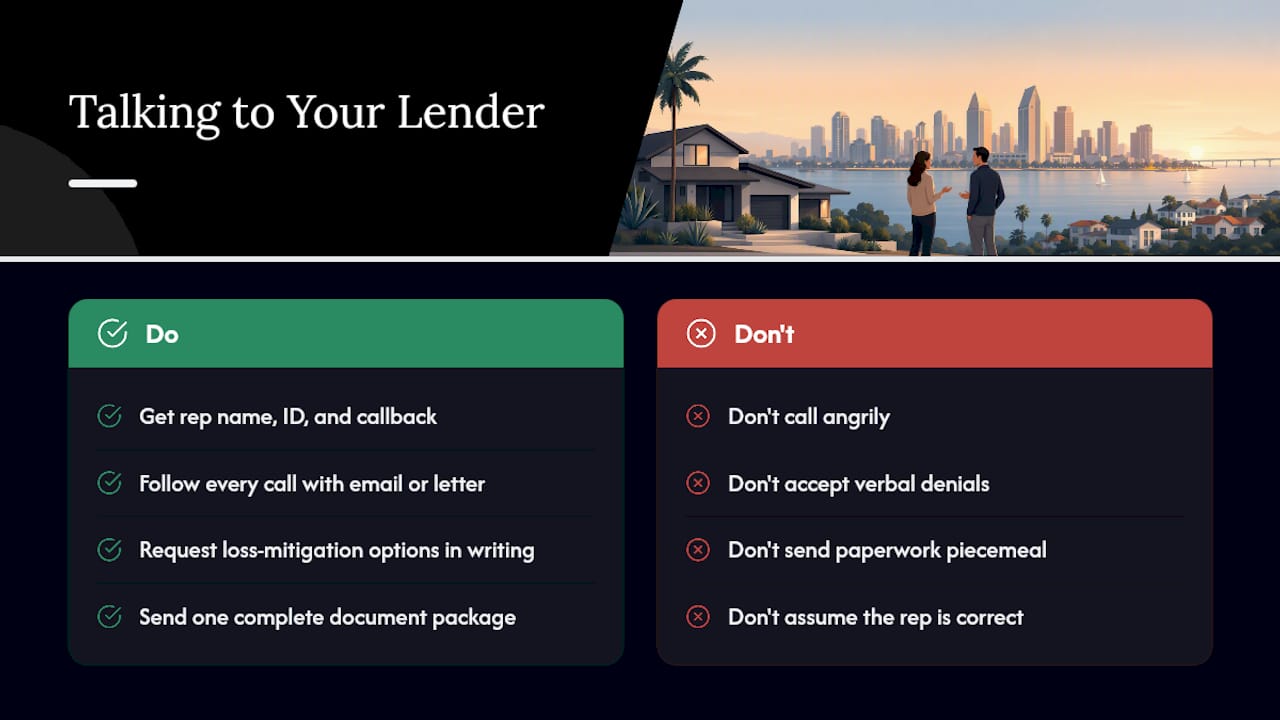
Loss mitigation departments are triaging hundreds of files at once, and the homeowners who get results are usually the ones who make their file easy to process, not the ones who call the angriest.
Start every call by asking for the representative's name, employee ID, and a direct callback number or extension. Follow every phone conversation with a short email or letter summarizing what was discussed and requested, so there's a written record if the servicer's notes don't match what you were told. Request loss mitigation options in writing rather than accepting a verbal "there's nothing we can do," since written denials can often be appealed or reviewed by a supervisor.
Submit complete, organized document packages rather than piecemeal paperwork. A servicer that receives your hardship letter on Monday, your pay stubs on Thursday, and your bank statements the following week will restart its review clock every time something new arrives. Send it all together, and confirm receipt by phone within 48 hours.
If a customer service rep tells you something that contradicts your written notices, don't assume they're right. Ask to speak with a supervisor and get the answer in writing. A HUD-approved housing counselor or a loan modification specialist who works with servicers regularly can also translate what you're being told into what it actually means for your file.
What Local San Diego Resources Can Help You Right Now?
San Diego homeowners have more free support available than most people realize before they start looking. HUD-approved housing counselors serving San Diego County can review your loan file and help prepare a modification packet at no cost, and the process usually starts with a single phone call.
Legal Aid Society of San Diego runs foreclosure-specific intake for homeowners who need legal guidance on modification denials, bankruptcy options, or servicer violations of the Homeowner Bill of Rights. Beyond these two anchor resources, local nonprofits and counselors across the county help homeowners navigate repayment plans and short sales, sometimes with referrals to city or county emergency assistance programs for homeowners in acute financial distress.
None of these services require you to pay anything upfront, and that's worth repeating because it's exactly where scams try to insert themselves.
Jeff's Perspective: What Most Foreclosure Advice Gets Wrong
Most foreclosure content online treats this as a legal problem first. It isn't, not at the start. It's a communication and timing problem. The homeowners who come out of pre-foreclosure in the best shape aren't the ones who found the cleverest legal maneuver. They're the ones who picked up the phone in week one instead of week six.
Here's what I'd push back on: the advice to "explore all your options" before acting. That sounds responsible, but every week spent researching instead of calling your servicer and a HUD counselor is a week closer to a sale date, where your leverage evaporates. Chapter 13 filings and short sales both work far better when they're started with 60 days left on the clock rather than 10.
What actually matters, in order: confirm your exact timeline, get a free counselor and possibly Legal Aid on the phone this week, and then decide between keeping the house or selling it, not the other way around. Deciding first and researching second is how people burn their best window on the wrong option.
— Jeff
Need to Sell Fast? Here's How Jeff Can Help
If keeping the house isn't realistic on your timeline, selling on your terms beats losing the house on the bank's. Jeffsellssandiego offers a free home valuation so you know your real equity position within days, not weeks, and then works your listing with the urgency a pre-foreclosure timeline actually requires, not a standard 90-day marketing plan.

A consultation starts with a straight answer: whether you have enough equity for a traditional sale, whether a short sale conversation with your lender makes sense, and how fast a listing can realistically go live in your specific San Diego neighborhood. From there, Sell With Strategy covers pricing, marketing, and negotiating directly with buyers and, when needed, your lender's loss mitigation team. Get your free valuation started now and find out exactly where you stand before your next mortgage statement arrives.
Where to Get Help Right Now
- HUD housing counseling: (800) 569-4287, free guidance on every foreclosure-avoidance option.
- Legal Aid Society of San Diego: 1-877-534-2524, free legal intake and referrals.
- NOD timeline reference: 90-day post-NOD window before a trustee sale can typically be scheduled.
This article is general information, not a substitute for advice from a qualified financial advisor. Consult a qualified financial professional about your own circumstances before acting on anything here.
Sources
- How many missed payments before foreclosure in California? | Sternberg Law Group
- Hud
- Foreclosure resources | Legal Aid Society of San Diego
- Can bankruptcy stop foreclosure in San Diego? | Griffin Law Blog
FAQ
How Many Missed Payments Lead to Pre-Foreclosure in San Diego?
Lenders in California typically record a Notice of Default after three to four missed mortgage payments. Once that's recorded, you generally have about 90 days to cure the default or arrange another option before a trustee sale can be scheduled.
Can Filing Bankruptcy Stop a Foreclosure Sale in San Diego?
Yes, filing bankruptcy triggers an automatic stay that immediately pauses a scheduled foreclosure sale. Chapter 13 lets homeowners with steady income propose a plan to repay missed payments over a multi-year period, while Chapter 7 offers only a temporary pause.
Who Should I Call First if I'm Behind on My Mortgage?
Call your loan servicer first, then a HUD-approved housing counselor at (800) 569-4287 for free guidance on every option available to your specific loan. If you need legal help, the Legal Aid Society of San Diego intake line is 1-877-534-2524.
Is a Short Sale Better Than Letting a Home Go to Foreclosure?
A short sale generally does less damage to your credit than a completed foreclosure and can shorten how long you wait before qualifying for another mortgage. It requires lender approval and can take weeks to negotiate, so starting early in the pre-foreclosure window matters.
How Much Does It Cost to Work With Jeffsellssandiego on a Sale?
Jeffsellssandiego's fees depend on the specific services and transaction, and current pricing details are available directly on the site. A free home valuation is the fastest way to get a clear picture of your options and costs before committing to anything.