
An escalation clause offer is a purchase-contract addendum that automatically raises your bid past competing offers, up to a cap you set in advance. It's worth using only in genuinely competitive U.S. housing markets, since it can win you a home faster but also exposes your top price and creates real appraisal risk. The rest comes down to drafting it correctly.
TL;DR:
- Escalation clauses are most effective in competitive markets with multiple offers, recent above-asking sales, and buyers with sufficient cash reserves for appraisal gaps.
- They must include specific terms: a clear base offer, fixed increment, and verified proof of competing bids, with a properly documented hard cap to avoid disputes.
- Once triggered, escalation clauses raise the bid to the highest verified bid, but cannot exceed the predetermined cap, and may push prices above appraisals, requiring buyers to cover shortfalls.
- Using escalation clauses can expedite negotiations but also risks revealing your maximum price, potentially leading to offers at or near your cap regardless of what you are willing to pay.
- In markets with "highest and best" offers, or if you cannot absorb an appraisal shortfall, submitting a single flat offer at your maximum may be more strategic than using an escalation clause.
Table of Contents
- How an Escalation Clause Offer Actually Works
- When an Escalation Clause Makes Sense, and When It's Dead Weight
- The Trade-Off Sellers Force on Every Escalated Offer
- How to Draft an Escalation Addendum That Actually Holds Up
- What Happens If Your Escalated Price Beats the Appraisal
- Is an Escalation Clause Even Legal? What the Fine Print Determines
- A San Diego Agent's Take on Escalation Clauses
- Get Help Writing a Winning Offer in San Diego
- Where to Verify These Details Further
- Sources
- FAQ
How an Escalation Clause Offer Actually Works
An escalation clause has three moving parts: your base offer, your escalation increment, and your cap. The base offer is your starting bid. The increment is how much you agree to beat any competing offer by. The cap is the absolute highest price you'll pay, no matter what else comes in.
Here's how it plays out in practice:
- You submit an offer with a base price and a clause that escalates your bid by a fixed increment above any competing offer, up to a set cap.
- The seller receives another offer higher than yours; your clause triggers automatically, increasing your bid by the specified increment.
- If another offer arrives near your cap, the clause pushes your bid up to the cap and then stops.
- Offers exceeding your cap surpass your escalation clause, and you lose out as your clause can no longer increase your bid.
That last step is the one buyers forget. A cap is a hard stop, not a suggestion. Sellers also need proof that the competing offer is real before they'll act on your escalation, which is why serious addenda require a redacted copy of the rival contract or a signed net-proceeds statement rather than a listing agent's word. Without that verification step, an escalation clause can trigger off a bid that never existed.
When an Escalation Clause Makes Sense, and When It's Dead Weight
Escalation clauses earn their keep in specific conditions, not as a default add-on to every offer.
- Multiple showings in the first weekend, a property under 10 days on market, or an agent telling you three other buyers are circling.
- A metro or neighborhood where recent comparable sales closed above asking, a pattern local agents track closely.
- Enough cash reserves to cover a gap if the appraisal comes in under your escalated price.
Skip it when the seller specifically requests "highest and best" offers with a set deadline. That format asks for one final number, and an escalation clause adds nothing, since there's no live bidding to react to. Experian's guidance on escalation clauses also notes some sellers reject escalators outright because they'd rather compare clean numbers than chase a moving target. If your financing is tight or you can't absorb an appraisal shortfall, an escalator just sets you up to win a house you can't actually close on.
The Trade-Off Sellers Force on Every Escalated Offer
Escalation clauses cut both ways once they land on a seller's desk.
What works in your favor:
- The bidding adjusts automatically, so you're not sitting by your phone waiting to counter.
- It signals you're serious and financially prepared to compete.
- It can shorten the back-and-forth on a deal that would otherwise drag through multiple rounds of offers.
What works against you:
- Your cap tells the seller exactly how far you'll go, and a savvy listing agent will counter you straight to that number.
- A clean offer with fewer contingencies, or a straight cash bid, often beats an escalated offer even when your capped price is technically higher.
- When two buyers both submit escalation clauses, the clauses can trigger against each other until one buyer's cap runs out, and the seller ends up with a price neither buyer originally planned to pay.
Pro Tip: In markets where sellers expect multiple rounds of best-and-final offers, some agents skip the escalation clause entirely and submit a flat offer at their true maximum instead. It hides your ceiling and avoids handing the seller a built-in negotiating script.
How to Draft an Escalation Addendum That Actually Holds Up
A vague escalation clause is worse than no clause at all. Courts need definite terms to enforce a contract, and "we'll beat any offer" isn't one. Here's what a solid addendum needs to spell out.
- Base offer price. The number you're starting from, matching your primary purchase agreement exactly.
- Exact increment. A fixed dollar amount, not a percentage tied to a moving target, so there's no ambiguity about the math.
- Hard cap. The absolute ceiling, written in numbers and words so there's no room for a typo dispute later.
- Calculation basis. State whether the increment escalates against gross purchase price or net proceeds to the seller. These are not the same number once seller concessions or closing cost credits enter the picture, and that distinction is among the most common sources of enforceability disputes.
Beyond those four fields, build in a proof requirement:
- Require a redacted copy of the competing offer's signature page and price, or a seller-signed statement confirming the net proceeds of the rival bid.
- Specify what happens at a tie: does your offer remain active at the cap, or does it withdraw automatically if outbid?
- Make sure the addendum's price terms match your main purchase agreement word for word. Mismatched numbers between the two documents are a common reason offers get challenged.
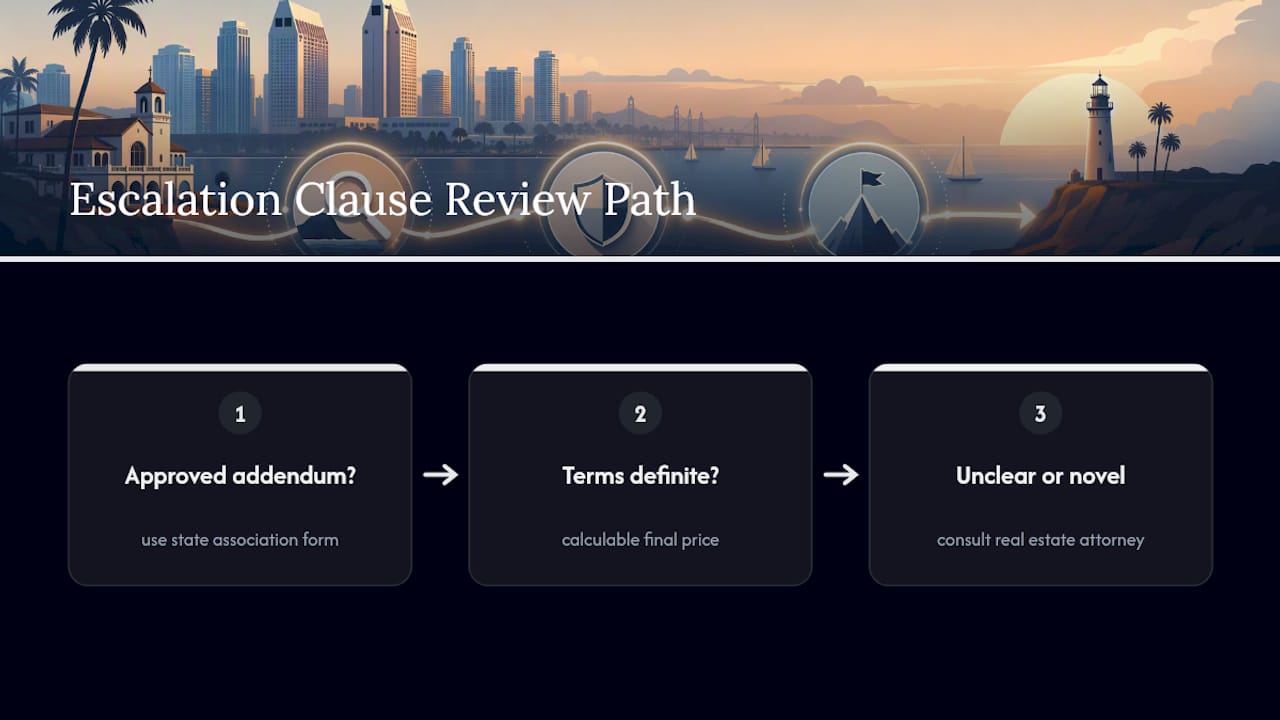
Sample escalation addendum language typically requires this proof step explicitly, specifically to stop a listing agent from inventing a phantom offer to drive up price. Where your state's realtor association publishes an approved escalation addendum, use it. Where one doesn't exist, get a real estate attorney to review your custom language before you submit it. A few hundred dollars in legal review is cheap insurance against a contract that falls apart during closing.
What Happens If Your Escalated Price Beats the Appraisal
Your lender doesn't care what you agreed to pay. It bases your loan amount on whichever is lower, the purchase price or the appraised value, and that gap becomes your problem, not the seller's. If your escalated price exceeds the home's appraised value, you are responsible for covering the difference in cash, assuming your loan-to-value calculations still permit the loan.
Buyers manage that risk a few ways:
- Add appraisal-gap coverage language committing to cover a shortfall up to a stated dollar limit.
- Increase your down payment cushion so a lower appraised value doesn't blow your loan-to-value ratio.
- Decide upfront whether you're waiving the appraisal contingency entirely or keeping it with a gap-coverage carve-out. Waiving it outright is more competitive but removes your exit if the numbers come in badly.
Before you set a cap, check three things: your actual preapproval limit, recent comparable sales in the neighborhood, and how much cash you have sitting outside the down payment. Jeff's guide to appraisal gap coverage walks through how San Diego buyers structure that commitment without overexposing themselves.
Is an Escalation Clause Even Legal? What the Fine Print Determines
Escalation clauses are legal throughout the United States, but legality isn't the same as enforceability. Contracts require definite, calculable terms, and a clause that leaves the final price open to interpretation can be thrown out or disputed at closing, according to LegalClarity's review of escalation clause enforceability.
Some state realtor associations publish standardized escalation addenda specifically to close that gap. Where no approved form exists, state regulatory bulletins caution agents against drafting novel legal language without an attorney's involvement, since a poorly worded clause can expose both the buyer and the brokerage to a contract dispute. If your agent hands you boilerplate language pulled from a template with no state approval behind it, that's the moment to loop in a real estate attorney before you sign anything.
A San Diego Agent's Take on Escalation Clauses
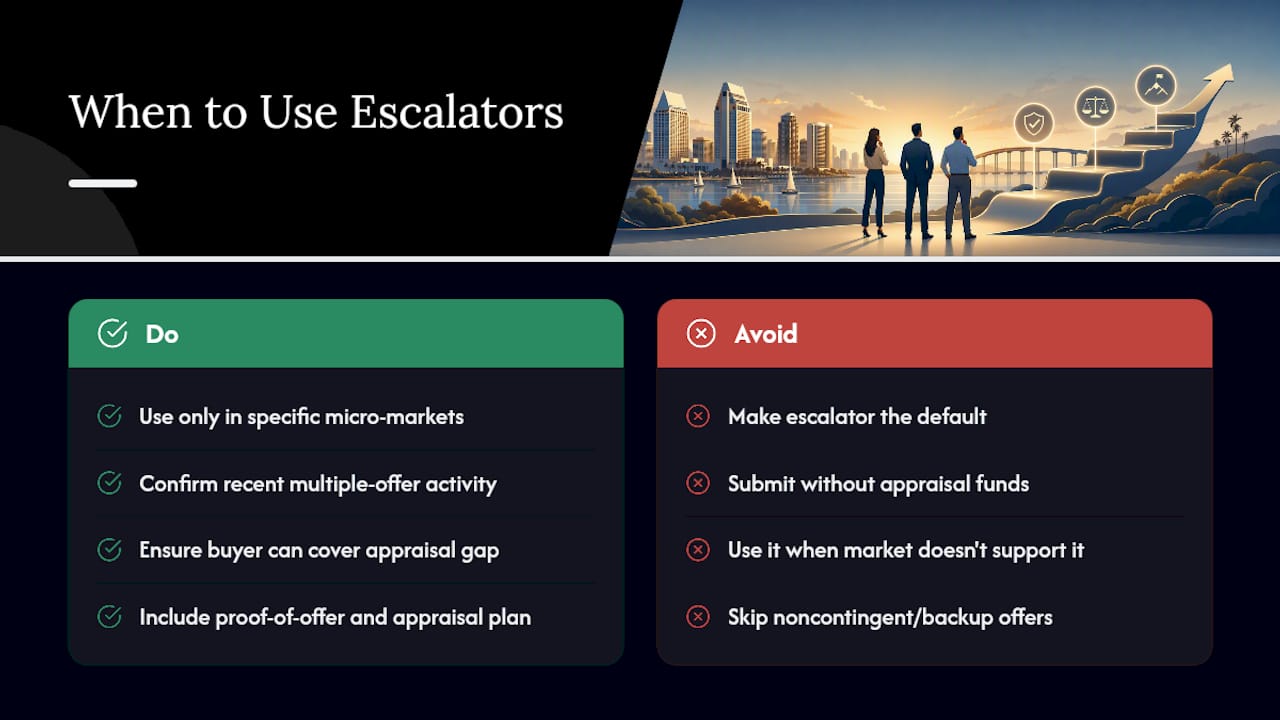
Escalation clauses work best as a scalpel, not a default setting. I use them in specific San Diego micro-markets, think coastal neighborhoods or well-priced homes in tight school zones, where I already know from recent activity that multiple offers are coming. I won't put one in front of a buyer who doesn't have the cash reserves to cover an appraisal gap, because that's how you win a house you can't close on.
Every escalation addendum I draft locks down the proof-of-offer language and pairs it with a clear appraisal-gap plan before we submit. If the market doesn't support an escalator, I'd rather build a strong noncontingent offer or line up a backup offer strategy instead.
— Jeff
Get Help Writing a Winning Offer in San Diego
A generic template off the internet won't protect you the way a locally drafted, attorney-sound escalation addendum will. An experienced agent represents buyers, drafting offers that account for appraisal-gap risk, proof-of-offer requirements, and the specific competitive pressure of the neighborhood you're bidding in, not a copy-pasted national template.

If you're gearing up to compete on a listing, start with Jeff's Buyer's Guide for a full walkthrough of offer strategy, then browse active home search listings to see what you're up against in your target neighborhood. A short consult before you write your first offer beats a scramble after you've already lost one.
Where to Verify These Details Further
For deeper mechanics and sample language, Freddie Mac's homebuying guidance and LegalClarity's escalation addendum walkthrough are solid starting points. For a custom clause, a real estate attorney remains your best resource.
Sources
- Should My Offer Include an Escalation Clause? - My Home by Freddie Mac
- What Is an Escalation Clause? - Experian
- Escalation Clauses in Real Estate: Enforceability and Risks - LegalClarity
- The Pitfalls of Using Escalation Clauses - NCREC Bulletins
FAQ
Should I Remove the Escalation Clause When Offering?
Remove it only if the seller has requested a single "highest and best" offer, or if you can't absorb a potential appraisal gap. In those cases, a flat offer at your true maximum protects your leverage better.
What Is a Typical Escalation Clause?
A typical clause states a base offer, a fixed dollar increment, and a hard price cap, with a requirement to see proof of any competing offer before the escalation triggers.
What Happens if My Offer Is Escalated?
Your offer automatically rises by the stated increment above the next-highest verified offer, stopping the moment it hits your cap, even if a higher competing bid still comes in afterward.
What Happens if Two Offers Have Escalation Clauses?
Both clauses can trigger against each other, pushing the price up incrementally until one buyer's cap runs out, meaning the buyer with the higher cap typically wins, often at a price higher than either side originally intended to pay.