
You can renovate a kitchen. You can replace the roof, repaint every wall, and gut the bathrooms. What you cannot do is move the house. That's why location matters in real estate more than any other single factor, and yet buyers routinely prioritize square footage or staging over the one thing that will determine long-term value and daily quality of life. This guide breaks down the real mechanics behind location value, from school district lines to commute costs, with 2026 market data to back it up.
Table of Contents
- Key takeaways
- Why location matters in real estate markets today
- Key location factors that drive property value
- The real cost of commute and location lock-in
- How to evaluate location before you buy
- My take on location as the real deciding factor
- Find your ideal San Diego location with Jeffsellssandiego
- FAQ
Key takeaways
| Point | Details |
|---|---|
| Location drives long-term appreciation | Markets vary sharply, with some cities gaining 5% while others drop nearly 9% in a single year. |
| School districts move prices significantly | Homes in top-rated school zones sell for 10% to 20% more, with premiums reaching 49% in competitive markets. |
| Neighborhood quality outranks price | 59% of buyers rank neighborhood quality as their top purchase driver. |
| Commute length adds hidden costs | Buying farther from job centers creates location lock-in and real lifestyle tradeoffs that compound over time. |
| Walkability commands a price premium | 78% of buyers would pay more for a home in a walkable area with sidewalks and nearby amenities. |
Why location matters in real estate markets today
No two local markets behave the same way, and 2026 data makes that crystal clear. Home values vary widely by location, with some cities posting gains of up to 5% while others have seen values drop nearly 9.1% in just one year. Across large U.S. metro areas, roughly 70% experienced value declines between 2025 and 2026. That spread is not random. It reflects economic momentum, population movement, and job market strength at the local level.
What drives this divergence? Think about the difference between a Sun Belt city absorbing remote workers and a Rust Belt market losing manufacturing jobs. Both are real estate markets on paper. In practice, they are entirely different investment environments. Population growth fuels demand, demand supports prices, and prices reflect the local economic story playing out underneath the surface.
| Metro Market Type | Typical 2025-2026 Value Trend | Primary Driver |
|---|---|---|
| High job growth corridor | +3% to +5% | Tech/remote work migration |
| Stagnant economic base | -3% to -6% | Population outflow |
| Severe inventory constraint | +1% to +3% | Limited supply, steady demand |
| Market correction zone | -5% to -9% | Prior overvaluation |
For investors, this means the importance of location in real estate is not just philosophical. It shows up directly in your return. Buying in a market with deteriorating economic fundamentals, no matter how good the property looks, is a structural mistake that renovation cannot fix.
Pro Tip: Before you analyze a specific property, run a quick economic health check on the metro area: job growth rate, population trend, and unemployment rate over the past 24 months. These three numbers tell you more about future appreciation than the current listing price.
Key location factors that drive property value
The neighborhood quality bundle is how buyers actually experience location. It is not one thing. It is a combination of school quality, safety, walkability, access to amenities, and community character that together produce a feeling of desirability. Understanding each piece helps you see where value comes from and where it can quietly disappear.
School districts and the price premium they carry
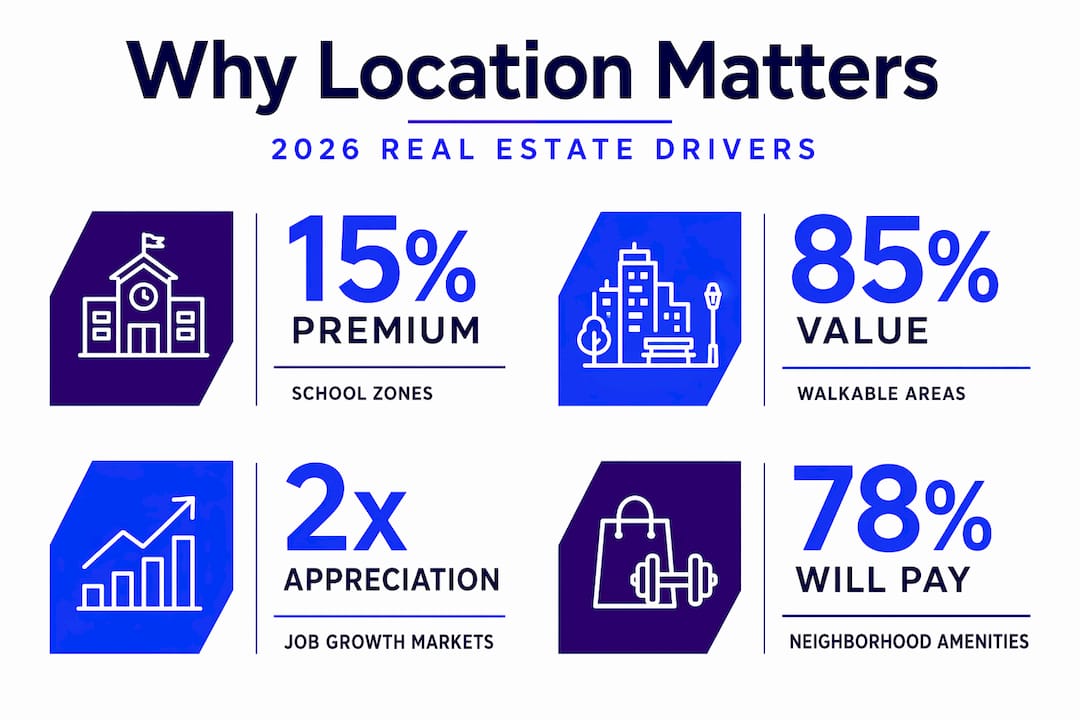
School districts are one of the sharpest location value drivers in residential real estate. Homes in top-rated school districts sell for 10% to 20% more than comparable homes elsewhere, with premiums reaching 49% in highly competitive markets. Even families without children buy into strong school zones because the resale market is deeper and more stable there.

What most buyers miss is the precision involved. School zone boundaries can shift property values by 5% to 15% for two houses that sit on the same street. If one falls into the higher-rated attendance zone and the other does not, they are not comparable properties in any meaningful sense, even if they look identical from the curb.
Walkability and neighborhood amenities
85% of Americans value walkable communities, and 78% say they would pay more for a home that puts sidewalks, parks, shops, and restaurants within walking distance. That preference is not just about lifestyle. It translates to real money at the closing table and faster sales in a slower market.
Walkable neighborhoods like Mission Hills and Hillcrest in San Diego demonstrate this dynamic well. The walkability premium on properties in those areas is measurable and persistent, because the desirability holds across different buyer profiles, from young professionals to retirees downsizing.
Here is a summary of the key real estate location factors and their relative weight:
| Location Factor | Impact on Value | Buyer Sensitivity |
|---|---|---|
| School district rating | High (10%–49% premium) | Very high |
| Walkability score | Moderate to high | High |
| Proximity to job centers | High | High |
| Safety and crime rate | High | Very high |
| Access to parks/amenities | Moderate | Moderate to high |
| Future development plans | Variable | Growing |
Pro Tip: Walk the neighborhood at different times of day before making an offer. What a street looks like at 10 a.m. on a Tuesday and 9 p.m. on a Friday tells you two very different things about community character.
The real cost of commute and location lock-in
Here is a dynamic that rarely gets enough attention in home buying conversations. Homeowners commute approximately 6.9% longer than renters, adding more than 15 extra minutes per week on average. That gap exists because affordability pressure pushes buyers away from job centers. The further you go to find a price that works, the longer you drive to get to work.
This is the "drive-'til-you-qualify" phenomenon, and it carries costs that most buyers underestimate at purchase time:
- Time loss. An extra 30 minutes each way adds up to roughly 130 hours per year gone from your life.
- Transportation costs. Fuel, maintenance, and vehicle depreciation are real expenses that do not show up in your mortgage payment.
- Health and wellbeing. Research consistently links long commutes to higher stress, lower sleep quality, and reduced physical activity.
- Resale risk. If commute tolerance shifts in a market, demand for far-out locations can soften faster than average.
The deeper issue is location lock-in. Once you buy 45 minutes from downtown, you are betting that buyers in your price range will always accept that commute. When remote work expands, they might. When employers tighten return-to-office policies, that demand can shrink fast. Location lock-in is a real investment risk that gets buried under enthusiasm about price per square foot.
The trade-off is not always wrong. Buying farther out to get more space, a better school district, or a quieter neighborhood can be the right decision. The mistake is making it without honestly pricing in the full cost of commute and the resale implications of that location choice.
How to evaluate location before you buy
Practical application is where the importance of location in real estate becomes real for buyers and investors. Here is a step-by-step framework for assessing location value before you commit:
-
Verify school district boundaries directly. Do not assume based on neighborhood name. Look up the exact attendance zone on the district's official website, because a few blocks can put you in a completely different school and a different price tier.
-
Check neighborhood fit against your lifestyle. A California neighborhood guide gives you a starting point, but walk the area, visit local coffee shops, and observe what the community actually feels like during your daily routine hours.
-
Research economic fundamentals in that specific zip code. Look at job growth nearby, new employer announcements, and any planned infrastructure. NAR's top 10 homebuying hot spots for 2026 outperform national averages precisely because they have strong economic and demographic tailwinds underneath them.
-
Score walkability and transit access objectively. Use tools like Walk Score alongside your own on-the-ground observation. A high walkability score in a neighborhood correlates directly with broader buyer appeal and long-term demand.
-
Investigate future development. A vacant lot next to a property you love might become a park or a warehouse. Zoning maps, city council meeting minutes, and local planning department filings are public information. Use them.
-
Run a realistic commute test. Drive your actual commute at the exact time you would do it on a workday. Not Google Maps estimated time. The real thing. Budget both the time and the annual fuel cost into your true housing expense.
Pro Tip: Neighborhood-specific location intelligence helps buyers answer personalized questions about commute, schools, and amenities before they fall in love with a property. Ask your agent for this data before you tour, not after.
My take on location as the real deciding factor
I have worked with buyers in San Diego long enough to watch the same mistake play out repeatedly. Someone finds a beautiful home, great finishes, big yard, perfect layout. Then they talk themselves into the location because the house checked every other box. Six months after closing, the commute is grinding them down and the neighborhood does not fit their life. The house did not change. The location just did not work.
What I have learned is that location significance in home buying is about personal fit as much as market data. Two buyers can look at identical data for the same neighborhood and reach opposite conclusions, because their work locations, social lives, kids' ages, and daily routines differ. I push my clients to spend time in a neighborhood before making an offer, not just driving through it once on a Sunday afternoon.
The 2026 data also reinforces something I have believed for a while. Buyers are getting more sophisticated about location. They are asking about school zone lines, not just school reputations. They are running walkability scores before scheduling tours. They are thinking about what a neighborhood will look like in ten years, not just today. That is a healthy shift. The best locations for real estate investment are the ones where multiple buyer profiles want to be, which creates durable demand regardless of market cycles.
The one thing I would add that most articles skip: do not let price anchor your location standard. A $50,000 savings on a home in the wrong location is often a false economy once you factor in the commute, the weaker school zone, and the narrower resale pool. Location is the one part of a home you cannot change. Price everything else accordingly.
— Jeff
Find your ideal San Diego location with Jeffsellssandiego
Knowing why location matters is the first step. Translating that knowledge into the right property in the right San Diego neighborhood is where Jeffsellssandiego comes in. Jeff Hinds brings neighborhood-level expertise across San Diego's diverse communities, from walkable urban neighborhoods to family-focused suburbs with top-rated schools.

Whether you are a first-time buyer trying to decode school zone boundaries or an investor looking at appreciation potential by zip code, Jeff gives you the specific, localized insights that generic listing searches cannot provide. Start with the San Diego home search to explore available properties by neighborhood, or dive into the San Diego neighborhood guide to compare communities side by side. When you are ready to talk specifics, Jeff is available to walk you through exactly what the data means for your situation.
FAQ
Why does location matter more than the property itself?
Location determines long-term appreciation, demand, and resale depth in ways that no renovation can replicate. Property features can be upgraded; the surrounding neighborhood, school district, and job access cannot.
How does location affect property value in practical terms?
School district quality, walkability, proximity to employment, and neighborhood safety each carry measurable price premiums. Homes in top-rated school zones alone command 10% to 20% more than comparable properties outside those boundaries.
What are the best locations for real estate investment in 2026?
Markets with strong job growth, population inflow, and constrained housing supply lead the pack. NAR's 2026 hot spots show existing-home sales up 14% and prices rising approximately 4% in top-performing markets.
How do I evaluate a neighborhood before buying?
Verify school attendance boundaries directly, test your actual commute during peak hours, check walkability scores, and research local economic indicators including job growth and planned development projects in that specific area.
Does commute distance really impact home value?
Yes. Long commutes create location lock-in risk and limit your future buyer pool to people who also accept that commute. As homeowners commute roughly 6.9% longer than renters on average, affordability-driven distance trades are a genuine market factor.