
Dual agency is defined as a real estate arrangement in which one agent or brokerage represents both the buyer and the seller in the same property transaction. This creates an immediate conflict of interest because a seller wants the highest possible price while a buyer wants the lowest. Understanding what dual agency means before you sign anything is one of the most consequential decisions you will make in a real estate deal. The stakes are real: fiduciary duties conflict when a single agent serves opposing sides, and the party with less information almost always loses ground.
What is dual agency and how does it work?
Dual agency occurs when one licensed real estate agent, or two agents from the same brokerage, represent both the buyer and the seller in a single transaction. The agent shifts from advocate to neutral facilitator. Instead of fighting for your best price or terms, the agent is legally required to stay neutral and cannot share confidential information that would benefit one side over the other.
The most common way dual agency arises is not through a deliberate choice. Buyers often contact the listing agent directly after seeing a home online, not realizing that agent already works for the seller. The moment that agent agrees to show you the home and guide your offer, dual agency begins. You have effectively handed your negotiation to someone whose first loyalty was already committed.

Most states require written disclosure and consent before dual agency can proceed. The agent must inform both parties in writing that they will represent both sides, and both parties must sign a consent form. Without that disclosure, the arrangement is illegal in virtually every state that permits dual agency at all.
Pro Tip: If you call the number on a yard sign or a Zillow listing, you are calling the seller's agent. Ask immediately whether they represent the seller before sharing any information about your budget or motivation.
Here is how dual agency typically unfolds in practice:
- A buyer contacts the listing agent directly after finding a property online
- The agent discloses the dual agency relationship in writing
- Both buyer and seller sign consent forms acknowledging the arrangement
- The agent proceeds as a neutral facilitator, not an advocate for either side
- One commission check covers both sides of the transaction
What are the pros and cons of dual agency?
The case for dual agency is mostly about convenience. With one agent handling both sides, communication moves faster. There is no back-and-forth between two agents scheduling showings or relaying counteroffers. For straightforward transactions where both parties already agree on price and terms, that efficiency is real.
The financial picture is also worth understanding. In a standard transaction, the total commission of roughly 5 to 6 percent of the purchase price is split between the buyer's agent and the seller's agent. In dual agency, the agent earns the full commission from both sides, which means their financial incentive is to close the deal at or near the listing price rather than push hard for a lower number. That is not a conspiracy. It is just math.
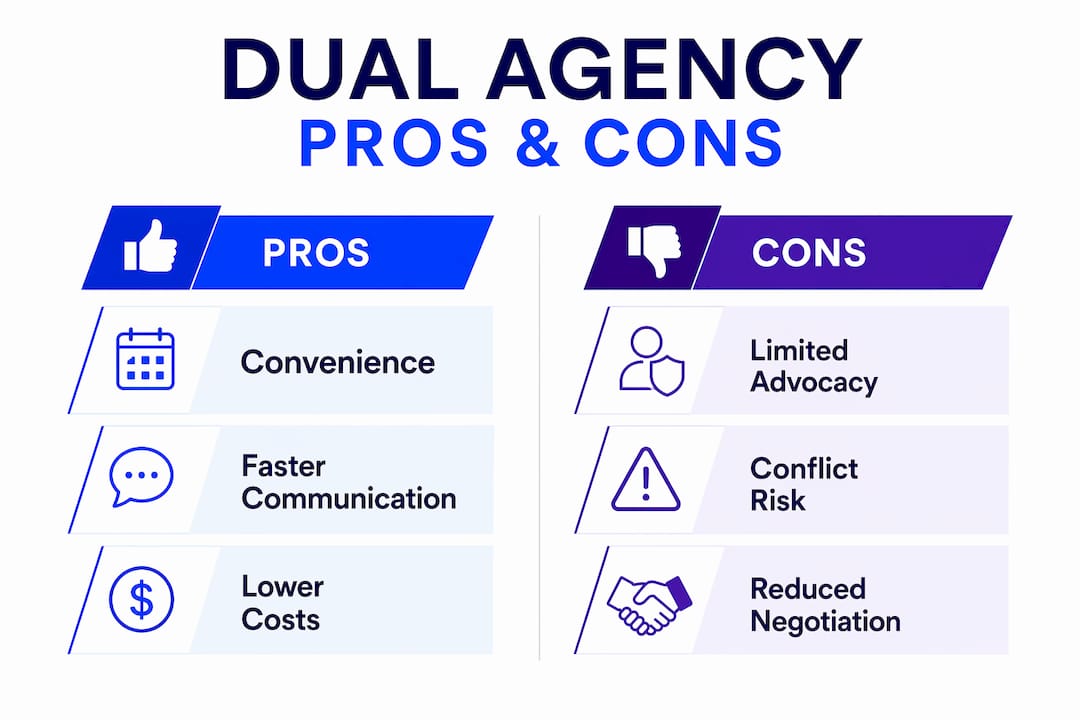
The risks, however, outweigh the conveniences for most buyers and sellers. Dual agency limits advice and negotiation effort on both sides. The agent cannot tell the buyer that the seller is desperate and would accept less. The agent cannot tell the seller that the buyer is pre-approved for far more than their offer. Both parties are flying partially blind.
| Factor | Dual agency | Separate agents |
|---|---|---|
| Advocacy | Neutral facilitator only | Full advocate for your side |
| Communication speed | Faster, one point of contact | Slightly slower, two agents coordinating |
| Negotiation strength | Reduced for both parties | Full negotiation on your behalf |
| Commission structure | Agent earns full commission | Commission split between two agents |
| Confidentiality | Limited, agent knows both sides | Protected within your representation |
Pro Tip: If a seller offers to reduce the sale price in exchange for you using their listing agent, run the numbers carefully. A 1 percent price reduction on a $700,000 home is $7,000. That is real money, but losing $20,000 in negotiation because your agent could not advocate for you costs far more.
The post-2024 NAR settlement increased scrutiny on dual agency, pushing regulators and consumers alike to question whether the arrangement ever truly serves both parties. The settlement changed how buyer's agent compensation is disclosed and negotiated, making the financial dynamics of dual agency even more visible than before.
How is dual agency different from designated agency?
Designated agency is the arrangement most consumers think they are getting when they hear "dual agency." In designated agency, a brokerage represents both the buyer and the seller, but assigns separate agents within the brokerage to each party. Each agent can still advocate fully for their client because they are not the same person.
The distinction matters enormously in practice. In true dual agency, one agent knows everything about both sides. In designated agency, Agent A knows your budget and motivation, and Agent B knows the seller's timeline and bottom line. Neither agent is required to share that information with the other. Your fiduciary duties remain intact.
Several states have moved away from permitting true dual agency precisely because designated agency solves the conflict-of-interest problem without sacrificing the brokerage relationship. Understanding which arrangement your state allows, and which your agent is actually offering, is a question worth asking directly.
| Agency type | Who represents you | Fiduciary duty | Conflict of interest |
|---|---|---|---|
| Single agency | Your own dedicated agent | Full fiduciary duty | None |
| Designated agency | Separate agent within shared brokerage | Full fiduciary duty | Low, agents are separate |
| Dual agency | Same agent for both parties | Neutral facilitation only | High, one agent knows all |
When you review a buyer representation agreement, look specifically for language about how your brokerage handles in-house transactions. Some agreements automatically convert to dual agency if your agent's brokerage holds the listing you want to buy. That clause is worth negotiating before you sign.
What should you ask before agreeing to dual agency?
Consumers must ask explicit questions about confidentiality and conflict handling before signing any dual agency consent form. Most people skim the disclosure and sign because the agent is standing there waiting. That is a mistake that can cost you thousands of dollars in a transaction worth hundreds of thousands.
Here are the questions to ask before you consent:
- What specific information about the other party will you be prohibited from sharing with me?
- If I tell you my maximum budget, are you required to keep that confidential from the seller?
- How will you handle a situation where the seller wants a term that directly harms my interests?
- Have you represented both sides in a transaction before, and what was the outcome for each party?
- Can I hire my own separate agent instead, and what happens to the commission structure if I do?
Read the consent form line by line. The form will specify exactly what duties the agent is waiving and what protections you are giving up. If the language is vague, ask for clarification in writing. Reviewing common home-buying mistakes before you sign any agency agreement will also help you spot the red flags that first-time buyers routinely miss.
Pro Tip: Never share your true motivation or maximum price with a listing agent before confirming your representation status. Once that information is out, you cannot take it back, regardless of what the disclosure form says.
What states allow or restrict dual agency?
The legal status of dual agency varies significantly across the United States. At least eight states have banned or heavily restricted dual agency as of 2026, with the remaining states permitting it under disclosure and written consent requirements.
| State | Dual agency status | Key rule |
|---|---|---|
| Colorado | Banned | Agents must choose one party to represent |
| Florida | Permitted with disclosure | Written consent required from both parties |
| Texas | Effectively banned | Agents act as intermediaries, not dual agents |
| California | Permitted with disclosure | Written consent and full disclosure required |
| Maryland | Permitted with disclosure | Designated agency preferred by most brokerages |
Colorado and Texas effectively prohibit the traditional dual agency model by requiring agents to either represent one party or act as a neutral intermediary with severely limited duties. Florida and California permit it but require written consent that clearly explains the limitations. If you are buying or selling in San Diego, California law requires your agent to disclose the dual agency relationship and obtain your written consent before proceeding.
Key takeaways
Dual agency is a high-risk arrangement for most buyers and sellers because one agent cannot fully advocate for opposing interests, and the financial incentive to close the deal quickly works against aggressive negotiation on either side.
| Point | Details |
|---|---|
| Core definition | One agent or brokerage represents both buyer and seller in the same transaction. |
| Primary risk | The agent cannot advocate for either party, limiting negotiation on price and terms. |
| Commission conflict | Dual agents earn the full 5 to 6 percent commission, reducing motivation to negotiate hard. |
| Designated agency difference | Separate agents within one brokerage preserve full fiduciary duties for each client. |
| Legal landscape | At least eight states ban or restrict dual agency as of 2026; others require written consent. |
My honest take on dual agency in San Diego
I have worked with buyers and sellers in San Diego long enough to say this plainly: dual agency almost never serves both parties equally. One side always gives up more than they realize. The arrangement looks convenient on paper, but convenience in a transaction worth $800,000 or more is not a good enough reason to waive your right to full representation.
The post-2024 NAR settlement changed the conversation around buyer representation in ways that make dual agency even harder to justify. Buyers now sign representation agreements upfront, which means the question of who is advocating for you gets asked earlier in the process. That is a good thing. It forces the conversation before anyone falls in love with a property and loses their negotiating leverage.
What I tell my clients is simple. If you contact a listing agent directly and they suggest dual agency, ask whether there is another agent at their brokerage who can represent you instead. That is designated agency, and it preserves your advocacy without blowing up the deal. If the brokerage cannot offer that, find your own agent. The buyer representation process exists precisely to protect you from situations like this.
The one scenario where dual agency makes sense is when both parties already know each other, have agreed on price and terms independently, and simply need an agent to handle the paperwork. That is rare. In a competitive San Diego market where every dollar of negotiation matters, going in without a dedicated advocate is a risk I would not take.
— Jeff
Work with an agent who puts your interests first
If you are buying or selling in San Diego and want to understand exactly how agency representation affects your transaction, Jeffsellssandiego is built around clear disclosures and dedicated advocacy for every client.

Whether you are searching for your first home or pricing a property to sell, you deserve an agent whose only job is to fight for your outcome. Browse current San Diego listings or reach out directly to discuss how Jeffsellssandiego approaches representation, negotiation, and the agency choices that shape every deal. There is no obligation, and the conversation will save you from questions you did not know to ask.
FAQ
What does dual agency mean in real estate?
Dual agency means one real estate agent or brokerage legally represents both the buyer and the seller in the same transaction. The agent acts as a neutral facilitator rather than an advocate for either party.
Is dual agency legal?
Dual agency is legal in most U.S. states but requires written disclosure and consent from both parties. At least eight states, including Colorado and Texas, have banned or heavily restricted it as of 2026.
What are the biggest risks of dual agency?
The primary risk is that the agent cannot fully advocate for either side, which limits negotiation on price, terms, and contingencies. The agent also earns the full commission from both sides, reducing their incentive to push for a better deal.
How is dual agency different from designated agency?
Designated agency assigns separate agents within the same brokerage to represent the buyer and seller individually, preserving full fiduciary duties for each client. Dual agency uses one agent for both parties, eliminating dedicated advocacy on either side.
Can you refuse dual agency?
Yes. You have the right to decline dual agency and hire your own separate agent. Asking key questions about representation before signing any agreement protects your ability to make that choice.