
Not every agent at the table is working for you. That's the reality of real estate in San Diego, and it surprises more buyers and sellers than you'd expect. Many people assume that whoever shows them a home or handles their listing is automatically protecting their interests. That's not always true. Broker representation defines who legally owes you loyalty, who gets paid what, and what happens when things get complicated. If you're buying or selling a home in San Diego in 2026, understanding broker representation before you sign anything could protect your money, your timeline, and your peace of mind.
Table of Contents
- What is broker representation in San Diego real estate?
- Why broker representation matters: Core duties and responsibilities
- Seller vs. buyer representation: Key differences and agreements
- Understanding dual agency: Pros, cons, and unique risks
- Commissions and negotiation: What to expect in San Diego
- My perspective: The overlooked power of choosing the right side
- Ready to work with a broker who puts your interests first?
- Frequently asked questions
Key Takeaways
| Point | Details |
|---|---|
| Broker roles defined | Seller and buyer brokers have different duties and contracts—know which you need before hiring. |
| Fiduciary and ethical duties | California law requires brokers to put client interests first, disclose key facts, and act with honesty. |
| Commissions are negotiable | All broker fees in San Diego can be negotiated—buyers and sellers both have leverage. |
| Be cautious with dual agency | Having one broker represent both sides can create conflicts and limits how much they can advocate for you. |
| Local market knowledge matters | Understanding San Diego norms around commissions and agreements helps you get the best results in your transaction. |
What is broker representation in San Diego real estate?
At its core, broker representation means you've hired a licensed real estate broker, or one of their agents, to act on your behalf in a transaction. It's a formal, legal relationship created through a written contract. Without it, an agent may still help you, but they don't legally owe you the full range of duties that come with true representation.
In San Diego, as in all of California, there are two primary roles in any deal:
- Listing broker (seller's agent): Hired by the seller to market the property, attract buyers, and negotiate on the seller's behalf.
- Buyer's broker (buyer's agent): Hired by the buyer to search for properties, evaluate options, and advocate during offers and negotiations.
A representation agreement employs a broker with authority to market, negotiate, and earn a commission when the deal closes. That agreement is the foundation of everything. It spells out what the broker can do, for how long, and how they get paid.
One important distinction: Just because an agent shows you a home does not mean they represent you. Without a signed agreement, an agent could legally be working for the seller, not you.
San Diego's real estate landscape includes everything from beachfront condos to suburban single-family homes in diverse neighborhoods, each with its own pricing dynamics. Representation agreements in this market typically lock in an agent for 30 to 90 days, and listing agreements for sellers usually run 90 days or longer depending on market conditions and property type.
Understanding the structure of your agreement, who holds authority, and what fees are involved is the first step toward protecting yourself in any San Diego transaction.
Why broker representation matters: Core duties and responsibilities
The legal and ethical obligations that come with representation are not just formalities. They are real protections that can make or break your deal.
When a broker represents you, California law requires them to uphold a set of fiduciary duties. A fiduciary duty means the agent must put your interests first, above their own. The agency law disclosure required in California transactions outlines duties that include loyalty, full disclosure, obedience, and reasonable care, plus general duties like honesty and no misrepresentation to all parties.
Here's what each of those duties means in practice:
- Loyalty: Your agent cannot favor another party, including themselves, over your interests.
- Confidentiality: Personal details like your top price, financial urgency, or motivation to sell cannot be shared with the opposing side without your consent.
- Disclosure: Material facts that affect the property's value or desirability must be revealed to you, even if the seller prefers silence.
- Obedience: Your agent must follow your lawful instructions, even if they personally disagree with your strategy.
- Reasonable care: Your agent must use professional competence, not just goodwill, in every step of the transaction.
These duties translate directly into outcomes. For example, a listing agent who knows your home's roof needs replacement must disclose that to buyers, rather than hiding it. A buyer's agent who learns the seller is under financial pressure can use that information to negotiate a better price for you.
Pro Tip: Ask your agent directly: "Are you representing me as a fiduciary?" A good agent will not hesitate to say yes and explain what that means for your specific deal.
The concept of general duties also matters. Even if an agent doesn't formally represent you, they are still legally prohibited from lying to you or withholding information that could harm you. But that's a much thinner layer of protection compared to full fiduciary representation.
For sellers in San Diego, working with a skilled listing agent means you're not just maximizing home value through marketing. You're also protected against disclosure mistakes that could lead to lawsuits after closing. The Seller's Guide lays out exactly what responsibilities you take on and how an agent protects you through the entire process.
Seller vs. buyer representation: Key differences and agreements
Knowing the duties is important, but understanding how representation actually plays out for each side of the deal gives you a much clearer picture before you commit to working with anyone.
| Feature | Seller representation | Buyer representation |
|---|---|---|
| Agreement type | Listing agreement | Buyer-broker agreement |
| Agent's primary role | Market the home, negotiate offers | Search, evaluate, negotiate for buyer |
| Who they advocate for | Seller only | Buyer only |
| Commission source | Typically paid by seller at closing | Paid by seller or directly by buyer |
| Typical contract length | 90+ days | 30 to 90 days |
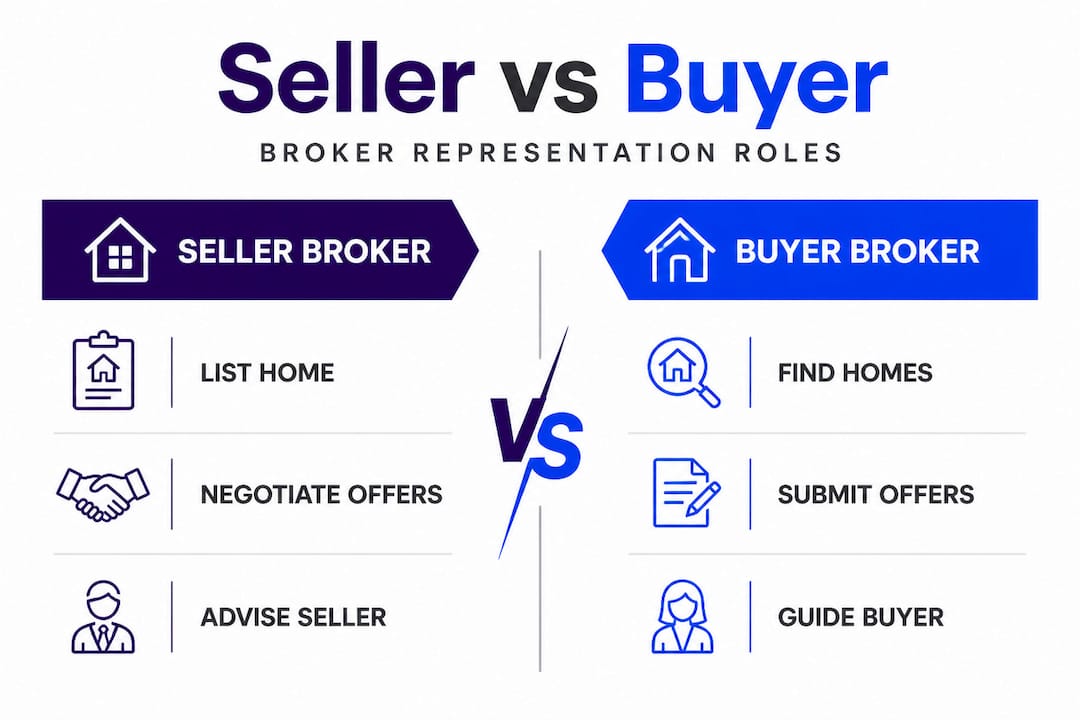
Seller representation starts with a listing agreement. This contract authorizes your agent to list your home on the MLS (Multiple Listing Service), market it to potential buyers, and negotiate on your behalf. Your agent's loyalty legally belongs to you as the seller throughout the process.

Buyer representation begins with a buyer-broker agreement, which became far more common and more scrutinized after the 2024 NAR (National Association of Realtors) settlement. Under that settlement, buyer's agents must now have a written agreement before showing homes, and compensation must be clearly disclosed upfront.
Here's a simple approach to reviewing any representation agreement:
- Check the duration. Know exactly how long you're committed and what the cancellation terms are.
- Review the compensation clause. Understand who pays the agent and under what conditions.
- Confirm the scope. Make sure the agreement covers the type of property and geographic area you're focused on.
- Look for the exclusivity clause. Most agreements are exclusive, meaning you can't use another agent during the term.
- Clarify dispute resolution. California agreements typically include mediation and arbitration provisions.
Listing exclusivity and fees can be especially important in inherited property situations, where sellers are sometimes unfamiliar with their obligations and default timelines.
Seller agent commissions typically run 2 to 3.5% of the sale price for the listing side, with buyer broker compensation ranging from 1 to 3%, all of which is negotiable. In 2026, that negotiability is more real than ever.
Pro Tip: In a seller's market where homes move fast, buyers who already have a signed buyer-broker agreement in place are taken more seriously by listing agents because their representation is established and their agent is ready to move.
Understanding dual agency: Pros, cons, and unique risks
Dual agency is one of the most talked about and misunderstood situations in residential real estate. It happens when one agent, or one brokerage, represents both the buyer and the seller in the same transaction.
Dual agency is legal in California with written consent from both parties, but it significantly limits the advocacy each side receives. By law, a dual agent cannot fully represent either party because full loyalty to one would harm the other.
The risks of dual agency include:
- Your confidential information (like your maximum budget or minimum acceptable price) could be known by the same agent advising the other side.
- Negotiation is inherently limited. A true advocate fights hard for your position. A dual agent cannot do that for both of you simultaneously.
- Disclosure conflicts can arise. An agent representing both sides faces pressure when a material fact benefits one party but harms the other.
- Legal disputes after closing are more common in dual agency transactions, especially in complex deals.
| Dual agency: Pros | Dual agency: Cons |
|---|---|
| Streamlined communication | Reduced advocacy for both sides |
| Faster closing timeline | Conflict of interest risk |
| Agent earns full commission | Limited negotiation on your behalf |
| Simpler logistics in some cases | Legal exposure if issues arise later |
A common scenario in San Diego: You tour an open house, fall in love with the property, and the listing agent offers to write the offer for you. That's dual agency. It might feel convenient, but you're giving up the agent who is fully in your corner.
In active neighborhoods like those around Point Loma, where demand often exceeds supply, dual agency situations come up frequently. Buyers who already have their own agent avoid this trap entirely.
Statistically, buyers represented by their own agent typically receive better negotiated terms than those in dual agency scenarios, even when the seller and buyer share the same brokerage. Having independent representation is almost always the more protective choice.
Commissions and negotiation: What to expect in San Diego
The money side of broker representation is where confusion is most common, and where San Diego buyers and sellers can either leave money on the table or walk into a deal fully prepared.
Total broker commissions in a San Diego transaction are negotiable by California law, with sellers typically paying 2 to 3.5% to the listing agent and 2 to 2.5% to the buyer's broker. Combined, that often lands between 4% and 6% of the sale price. On a $900,000 San Diego home, that's between $36,000 and $54,000 in total commissions.
Post-NAR settlement changes in 2025 and 2026 have made commission structures more transparent and truly negotiable:
- Sellers are no longer required to offer buyer-broker compensation through the MLS.
- Buyers may need to pay their own agent directly if the seller declines to cover it.
- All compensation terms must be written in the buyer-broker agreement before the first showing.
- Agents must be able to clearly explain and justify their fee.
This shift is significant. In neighborhoods like San Carlos, where median home prices give agents less room to negotiate, understanding these new norms helps you benchmark what's fair before you start the conversation.
When you're comparing property costs across different property types, like a condo versus a single-family home, agent fees are one of the recurring costs that can shift your total transaction budget by thousands of dollars.
Pro Tip: Never assume the commission rate is fixed. Start the conversation early, ask what services are included at each rate, and get everything in writing before you list or start touring homes.
Here's a practical checklist for negotiating broker fees:
- Research what comparable properties in your neighborhood have offered for broker compensation.
- Understand the full scope of services included in the quoted rate.
- Ask if the rate changes based on the final sale price or timeline.
- In a buyer-paid model, confirm whether the seller will credit you for agent costs at closing.
- Always compare two or three agents before committing.
My perspective: The overlooked power of choosing the right side
Here's something most articles won't tell you: The type of representation you choose matters less than the specific agent you choose within that representation. A brilliant dual agent who is transparent and skilled will serve you better than a poorly matched exclusive agent who is unavailable or inexperienced.
That said, I've seen too many San Diego buyers walk into a transaction without a signed buyer-broker agreement, assume the listing agent is "on their side," and then wonder why the deal felt lopsided. Representation is a legal status, not a vibe. The agent who seems friendly at the open house is, by contract, working for the seller.
The smartest buyers and sellers I've worked with treat their broker agreement the same way they treat any contract with real financial consequences. They read it. They ask hard questions. They negotiate terms. And they choose an agent whose market knowledge and communication style genuinely align with their goals, not just whoever picked up the phone first.
San Diego is not a market where you can afford to wing it. With median home prices staying well above $800,000 in most desirable neighborhoods, the cost of poor representation is not just inconvenient. It's measurable. Understanding broker representation is not bureaucratic homework. It's one of the highest-return decisions you can make before a transaction begins.
Ready to work with a broker who puts your interests first?
Knowing how broker representation works is the clearest path to a smoother, smarter real estate transaction in San Diego.

Whether you're buying your first home in a competitive neighborhood or selling a property you've owned for years, having the right representation behind you changes everything. Jeff sells San Diego with a clear focus on protecting your interests from the first agreement to the final signature. Explore the San Diego neighborhoods you're considering, review your options as a seller, and reach out to start the conversation with a broker who takes your representation seriously.
Frequently asked questions
Are real estate broker commissions in San Diego fixed by law?
No. Commissions are fully negotiable per California law. Typical ranges are 2 to 3.5% per side, but the actual amount is always something you can discuss and confirm in writing before signing any agreement.
What is the difference between a listing agent and a buyer's agent?
A listing agent represents the seller and markets the home to attract the best offers, while a buyer's agent represents the buyer's interests in finding and purchasing a property. Representation agreements for each side define different duties, compensation structures, and scopes of authority.
Is dual agency legal in San Diego?
Yes. Dual agency is allowed in California as long as both the buyer and seller provide written consent, but it restricts the agent's ability to fully advocate for either party and introduces a real risk of conflict.
Can a homebuyer refuse to sign a buyer-broker agreement?
Yes, a buyer can decline to sign, but buyers without agreements may find fewer agents willing to work with them seriously in competitive San Diego markets, and they may also lose the protection that a formal representation relationship provides.